
The “Year of the Pitcher,” 1968, was a forgettable one for the expansion Senators, other than homer champ Frank Howard. After climbing to sixth place in the 10-team American League during Gil Hodges’ last season as manager, the Nats had fallen into the cellar. The team would become the last ever in the A.L. to finish 10th.
Yet circumstances combined to make this July 26, 1968, Friday night game in Washington worthy of inclusion in MLB historian John Thorn’s series, “The Greatest Plays You Never Saw.” In January 2026, Thorn posted an account of a game-saving catch “unseen but remembered by David Lawrence Reed.” As a 16-year-old growing up in Boston’s Dorchester section, Reed was glued to the radio listening to his beloved Red Sox.
No photo or video of the play exists. The game was not televised. Few were from D.C. back then.
Thorn’s Medium post of Reed’s account brought deserved attention to the sensational catch by Red Sox centerfielder Reggie Smith. It came with two outs in the bottom of the ninth to rob the Senators’ Hank Allen of a game-winning, three-run, homer and preserve a Red Sox 2-1 victory.
What Smith did surely has never been forgotten by those still around who saw it. The eyewitnesses included Elston Howard, behind the plate that day for the Sox in his final big-league season. The former Yankee MVP called Smith’s catch “the best I have ever seen.” Howard’s fourth-inning homer proved to be the winning run. Smith had driven in the other with a third-inning single.
Local media coverage of the game didn’t exist. A brief strike and a picket line outside the stadium by unionized journalists at Washington’s three newspapers (the Evening Star, Post and Daily News) meant no beat reporters or news photographers from D.C. or from Boston, honoring the picket line, were on hand for the game at D.C. Stadium. (It wouldn’t be renamed Robert F. Kennedy Memorial Stadium until January 1969). An Associated Press reporter was allowed in. He was able to get post-game comments from the Red Sox locker room.
A crowd of just under 11,000 was on hand to watch the last-place Senators and the fourth-place Red Sox. After Boston scored twice off starter Frank Bertaina, he was lifted with two outs in the fourth for Dick Bosman (who would lead the league in ERA in ’69). He and Phil Ortega held the Sox to two singles the rest of the way. Still, the Nats couldn’t score off the veteran lefty Dick Ellsworth through the eighth inning.
In the bottom of the ninth, Ellsworth gave up a one-out single to Brant Alyea but then struck out Nats’ slugger Howard. Ken McMullen kept the Senators’ hopes alive with a single that moved Alyea to second. Paul Casanova then singled in Alyea to make it a one-run game.
With Allen (brother of Hall-of-Famer Dick Allen) due up, Boston manager Dick Williams headed to the mound. Ellsworth pleaded to stay in to get the last out. Williams reluctantly agreed, assuming that if he brought in his best right-handed reliever, the Nats would go to power-hitting left-hand batter Mike Epstein to pinch hit.
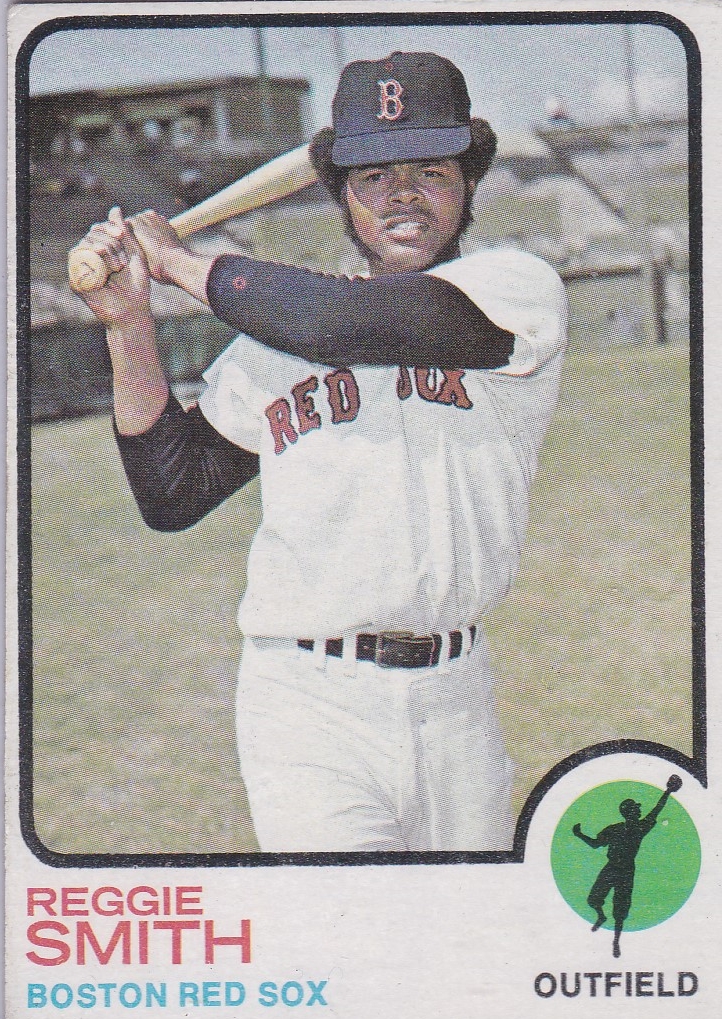
Ellsworth tried to throw a low fastball by Allen, but missed his target. Allen got all of it, sending a fly high and deep to left-center. The crowd began a full-throated roar as Smith raced back toward the seven-foot, chain-link, fence that surrounded the stadium’s outfield. “I thought it was a home run for sure,” Allen said.
Even so, Smith said he thought he might have a slight chance of catching the ball because it was hit so high.
Here’s how Reed described the next few seconds for Thorn, based on Red Sox radio voice Ken Coleman’s account:
“[Smith] leaped high onto the fence and, grabbing the crossbar at the top with his right hand, he pulled himself up so that his belt was even with the top of the fence. He then jackknifed his torso forward and, extending his left arm out and as far down as he could reach, made a backhanded grab of the ball, less than four feet from the bullpen floor.”
“Reggie Smith made the miracle catch” was the first line of the Associated Press story carried in Saturday afternoon newspapers around the country. (The feature story was written by James R. Polk, who went on to become a Pulitzer-prize winning investigative journalist.)
With the strike ended, the Washington Post on Sunday ran a catch-up summary under the headline, “Reggie Smith’s Catch Was Highlight in Three Days of Sports.” The Post’s story called Smith’s play “one of the greatest ever seen in D.C. Stadium.”
Somehow after making the catch, Smith maintained his balance enough to pull himself back up onto the field, rather than plunge headfirst into the Senators’ bullpen. Despite the catch stealing a victory from the home team, the crowd “loudly applauded Smith,” according to the Post’s Sunday summary.
“I couldn’t believe it myself,” Smith told the A.P. reporter. “When I caught the ball, I didn’t know what to do with it. I lost track of everything.”
Red Sox teammate, former Senator Ken Harrelson, said that as soon as it became clear the catch was made, he threw his glove 30 feet in the air. “I’m glad I saw that one — because if someone told me about it, I wouldn’t have believed it.”
Smith estimated his glove was about four feet into the bullpen when he snagged the ball in the webbing.
The only photo coverage was a post-game A.P. wirephoto of Smith kissing a ball and being hugged by Ellsworth in the clubhouse. It wasn’t the ball Smith caught, however. He had thrown that one in toward the infield and didn’t get it back, something he later said he regretted.
Amazingly escaping injury this night, Smith was hit on the foot by a pitch the next day and had to leave the game for an X-ray.
Smith had finished second in the Rookie-of-the-Year voting in 1967 and won the Gold Glove in center in ’68. He had a solid 17-year career — a 64.6 bWAR and 314 HRs — that included many, many highlights in the field. He made the first of seven All-Star teams the next season.
But when Reed, now in his 70s, interviewed the nearly 80-year-old Smith and asked him if this was his greatest catch, he didn’t hesitate.
“Oh, yes,” Smith replied, “It was.”

