
The awarding of World Series championship rings is a tradition that began more than a century ago when the New York Giants presented its players with the memento after defeating the Yankees in 1922.
The first ring was a simple gold band with “Giants World Champions 1922” and baseball bats engraved on it, with a small diamond in the center. Although more World Series’ winning team followed suit throughout the ’20s, the rings became a tradition every team has followed since the St. Louis Cardinals won in 1931.
Over the years, the designs of the rings have become far more elaborate. The rings awarded to the 2019 Washington Nationals were no exception. Even the baby shark was incorporated.
The design of the Nationals’ ring was unveiled in May 2020 while baseball was shut down for the Covid pandemic, just one of many events the team as the defending champs was unable to enjoy in front of its fans.
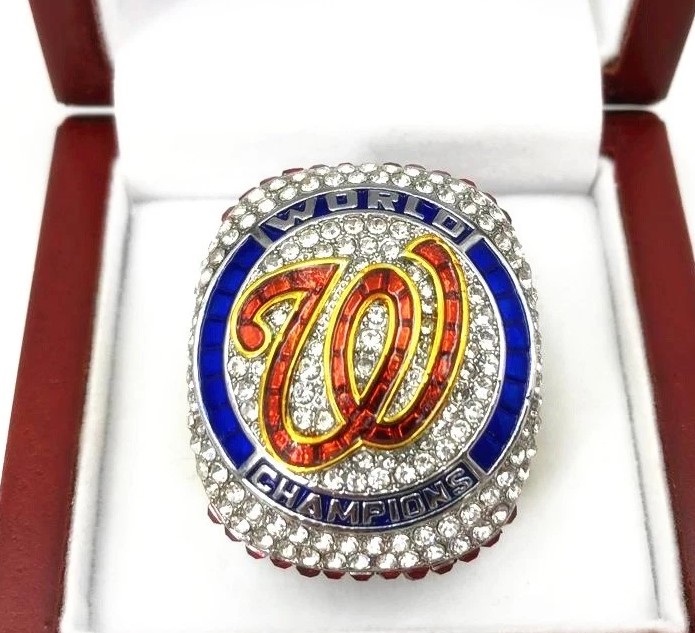
Each player’s last name is on his ring along with a dominant curly W formed with 30 rubies – the number of runs the Nats scored in their four wins over the Astros. Geraldo Parra’s baby shark, which became a 2019 Nats’ theme, is featured, holding the commissioner’s trophy. “Fight Finished” and “Go 1-0 Every Day,” then-manager Davey Martinez’s motto, are engraved inside the gold band.
The number of diamonds on the ring represents the team’s victory totals in the regular and post season. The U.S. capitol and an American flag are represented. How the jeweler Jostens managed to incorporate all this is quite a feat.
Reliever Sean Doolittle, now the assistant pitching coach, was a ring recipient and is the lone member of the 2019 squad still with the team.
Major League Baseball gives the winning team $1,500 a ring for each player, coach, manager and general manager. The team has to cover any additional costs for those rings and the full price of any additional rings. Sometimes, rings with fewer jewels are given to front-office clerical staff, groundskeepers and the like. Beyond the active players and coaches, the team owner decides who receives a ring.
Of course, the rings pale in comparison to each player’s share of the revenue for winning the World Series. Every National on the roster from June 1 until the end of the season was assured of receiving the winning players’ share of $382,358 — chump change for the big stars but real money for guys playing for the minimum and others who are voted full or partial shares.
How shares are awarded is based on voting by those roster players that is taken before the post-season begins. Front-office personnel aren’t eligible to get any of the World Series money.
Replicas of the Nationals’ ring are readily available on Amazon, eBay and elsewhere. The going price most commonly is about $30 or so.
If you’re wondering, rings are available on eBay designed to look like they might have, had they existed after Washington’s 1924 World Series win. However, no published evidence at the time mentions Clark Griffith awarding anything other than cash bonuses to members of his team.
Over the years, winning teams have included phrases and themes on their rings that became part of the teams’ identities, just as the Nationals did. For example, the 1979 Pittsburgh Pirates made sure “We Are Family,” the name of the Sister Sledge song, was on their rings. In 2016, the Chicago Cubs’ rings included 108 diamonds, the number of years since their last World Series win.
The player with the most World Series rings is not hard to guess. Hall of Famer Yogi Berra of the Yankees earned 10 of them as the catcher on that many World Series champions. Sadly, nine of his rings were stolen in 2014 from the Yogi Berra Museum and Learning Center in Little Falls, New Jersey, and are believed to have been melted down.

