
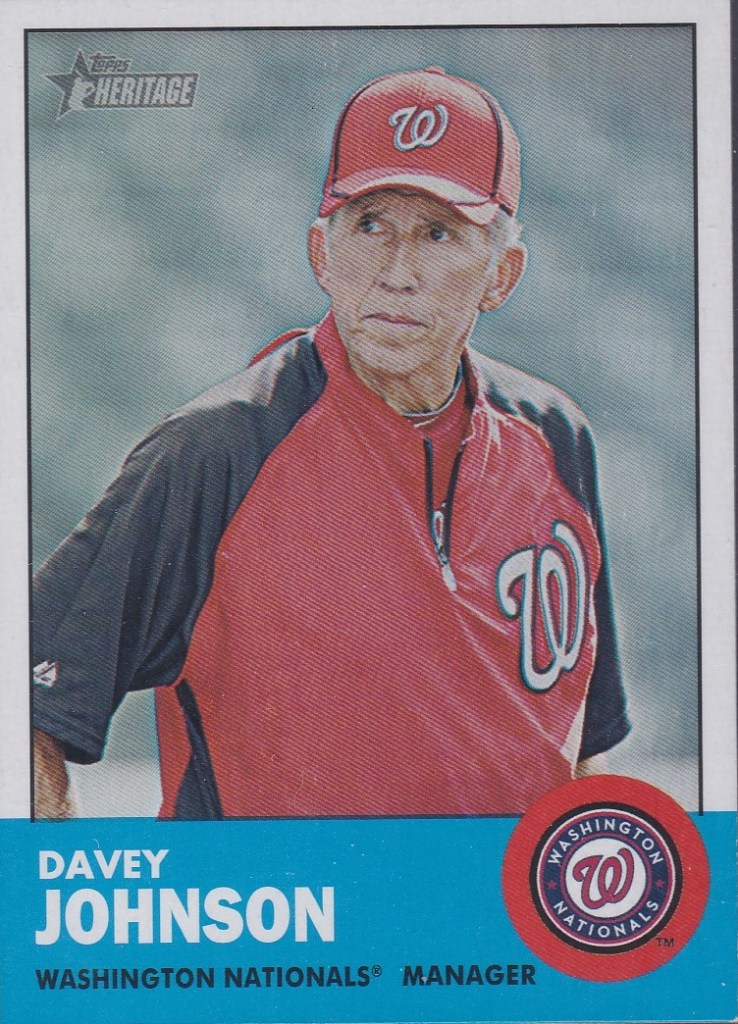
Former Nationals manager Davey Johnson led the team to its first N.L. East title in what also became its first winning season in 2012. For Johnson, who died at age 82 on Sept. 5, 2025, Washington was the last of five MLB teams he managed, all of them he made winners.
For me, Johnson’s tenure in D.C. brought back some of my best baseball memories. After the expansion Senators left for Texas, I lost interest in the game for next few years. Not long after, I took a job with a newspaper on the Jersey Shore in 1974.
By 1975, I was watching Mets games, all of which at that point were televised on channel 9 from New York. There’s no way a former Senators fan like me could support the Yankees, even if the Mets from 1977 through 1983 were awful. It felt just like following the expansion Nats in the ’60s.
Then in the fall of 1983, GM Frank Cashen hired Johnson to manage the Mets. In a weird twist, Johnson replaced the interim manager, former Senators’ slugger Frank Howard.
Cashen had been able to draft Darryl Strawberry and Dwight Gooden and to trade for Keith Hernandez, but it took Johnson’s field leadership to give the team the swagger it developed in 1984. Suddenly, the Mets were contenders and won 90 games. They were even better in ’85, winning 98 games and fighting the Cardinals for the N.L. East title.
Johnson pledged that 1986 would be the Mets’ year. He promised not just to finish first, but to dominate. That the Mets did, finishing 108-54, 21.5 games ahead of the second place Phillies. Manager Whitey Herzog of the Cards conceded in May that nobody would catch the Mets.
After a dramatic playoff victory over the Astros, Johnson’s Mets lost the first two World Series games to the Red Sox. The Mets won the next two. Bruce Hurst beat New York a second time in Game 5. In Game 6, the Red Sox scored two runs in the 10th. When the first two Mets’ hitters were retired in the bottom of the inning, Boston was an out away from ending the curse of the Bambino and winning its first World Series since 1918.
Singles by Gary Carter and Kevin Mitchell brought up Ray Knight. Calvin Schiraldi’s two quick strikes put the Red Sox a strike away from the title, but Knight’s line single to right-center scored Carter and sent Mitchell to third. Bob Stanley relieved Schiraldi but an inside pitch to Mookie Wilson eluded catcher Rich Gedman and brought Mitchell home with the tying run.
Wilson then hit a grounder toward Bill Buckner, playing on an injured leg at first. In one of the most famous World Series moments, the ball got under Buckner’s glove, allowing Knight to score the winning run and set up Game 7, which the Mets, of course, won.
Until 2019, that was the only time a team I followed became world champs.
As soon as the Expos moved to D.C., I knew I had to return to my roots and become a Nationals’ fan.
Davey Johnson won at least 87 games every year he managed the Mets, but in the days before the Wild Card, that was never enough to get back to the World Series.
He moved on the Reds, the Orioles and the Dodgers before becoming a consultant for the Nationals, then taking over as manager mid-way through the 2011 season, replacing Jim Riggleman, who grew up in the D.C. suburbs but quit when he wasn’t offered a contract extension.
For me, just as Hondo had given the Mets a Senators’ connection, Johnson gave the Nationals a Mets connection.
Johnson’s teams played in the post–season six times. Just once did a team he managed for a full season finish under .500.
Johnson proclaimed before 2013 that his goal was “World Series or bust.” Unfortunately, those Nats didn’t make the playoffs, and GM Mike Rizzo hired Matt Williams to replace Johnson.
Johnson played in four World Series with the Orioles, two of which they won. In the 1966, he got the last hit ever off Sandy Koufax and made the last out of the 1969 World Series, won by the Mets.
With Atlanta in 1973, he hit a then-record 43 home runs for a second baseman after never hitting more than 18 previously. He was a four-time All-Star and a three-time Gold Glove winner.
He was an early believer in the kind of analytics that became known as sabermetrics — not surprising as he had a math degree from Trinity University in Texas.
In a wonderful obituary tribute, Mark Zuckerman of MASN wrote that Johnson as a kid in Orlando had been a bat boy for the original Senators during spring training at Tinker Field.
“He knew how to get the best out of everyone — on and off the field,” retired National Ryan Zimmerman wrote in an online message. “I learned so much from him, and my career would not have been the same without my years with him.”
Johnson was “one of the smartest and most stubborn, loyal and insubordinate, independent and opinionated, honest and funny, patient and multifaceted men that baseball has ever seen,” Tom Boswell of the Washington Post, who covered Johnson in Baltimore and Washington, wrote in September 2013.
Like Boswell, I see Johnson as a worthy candidate for the Hall of Fame as was Joe Torre, based on the combination of their playing and managing careers. For that matter, that list could be expanded to include Clark Griffith, Casey Stengel and even Gil Hodges, all three arguably short of induction as players, but well worthy based on their overall achievements.
A version of this also appeared in the October 11, 2025, edition of Here’s the Pitch, the daily online newsletter of the Internet Baseball Writers Association.

