
Moe Berg was the backup catcher on the 1933 pennant-winning Senators and played most of three seasons with Washington. He gained greater glory by helping the U.S. intelligence service when he took a movie camera with him as part of a group of American major leaguers touring Japan in the fall of 1934.
Berg had three Ivy League degrees and spoke as many as 12 languages. (“He can’t hit in any of them,” pitcher Ted Lyons once famously quipped). He was a star shortstop for Princeton — he and his second-baseman exchanged signs in Latin — and made the majors with Brooklyn in 1923. He was cut after missing spring training in 1924 while studying in Europe.
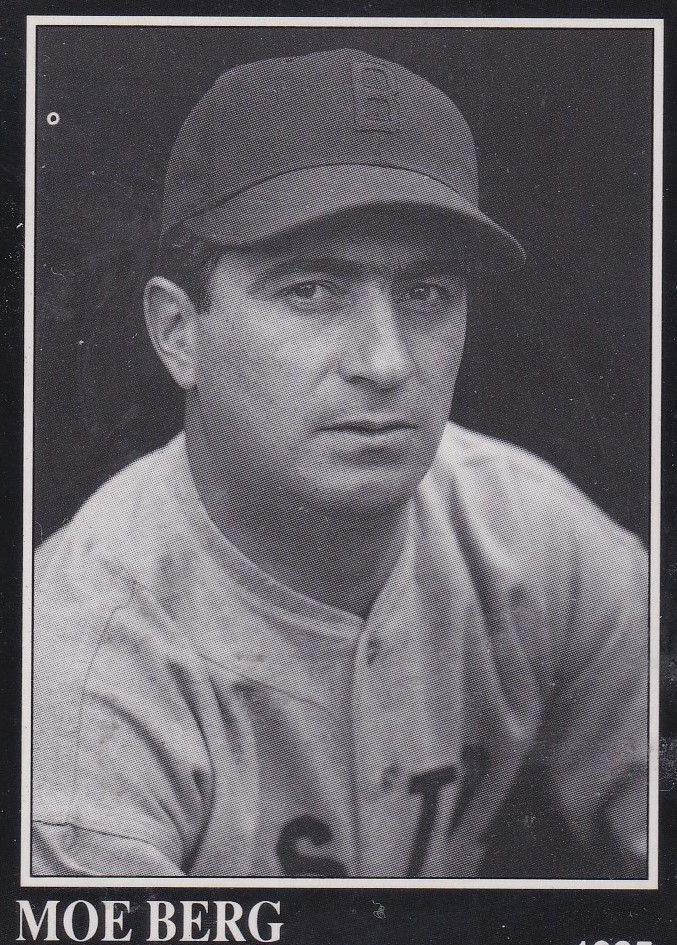
In the minors, he supposedly was the first player to be evaluated by a scout as “good field, no hit.” Still, he made it back to the majors in 1926 as a middle infielder with the White Sox. He had his best season after he volunteered to catch in 1929. He spent the next 12 seasons behind the plate. While in the majors, he earned a law degree at Columbia, but hated working as a lawyer and soon gave it up.
Berg is the only Senators’ player who has had a movie made about him. The Catcher Was a Spy, based on the Nicholas Dawidoff book of the same name, depicts his surreptitious use of a 16mm camera to film Tokyo from the roof of a tall hospital building on behalf of the Office of Strategic Services, the predecessor of the Central Intelligence Agency. Although just a backup, he was part of the post-season all-star team in 1934 playing exhibition games in the not-yet enemy nation.
Berg had first visited Japan in 1932 with Lefty O’Doul and Ted Lyons to tutor young players there. Before returning to the U.S., Berg visited China, India, Indo-China, the Philipines, Egypt and Germany.
Washington’s catcher in 1933, Luke Sewell, started 141 of the 154 games. Berg started the other 13 and appeared in just 40 games all season. He hit .185 and didn’t appear in the World Series, won in five games by the Giants. The Senators released him at the end of July the next season. He finished the year with Cleveland.
Back home, he signed with the Red Sox and played in Boston through 1939, never appearing in more than 47 games in a season. He finished with a lifetime average of .243. After retiring as a player, he coached for the Red Sox in 1940 and ’41.
Once American entered World War II, he was recruited by the OSS. Among other assignments, he spied on German scientists trying to develop a nuclear weapon. He sometimes worked for the CIA after the war.
Despite his brilliance in math, languages and the law, Berg spent much of the remainder of his life homeless and being treated for mental illness. He died at age 70 in 1972 from injuries sustained in a fall.
At that point he was living with his sister Ethel in New Jersey. After Berg’s death, she accepted the Medal of Freedom he was awarded, but had declined, in the late 1940s. Ethel donated the medal to the Hall of Fame in Cooperstown.
For more about Berg’s life, read Dawidoff’s book or Ralph Berger’s 2012 SABR BioProject essay.

