
Al Schacht threw 10 shutouts and won 19 games in the 1919 International League before pitching with minimal success for Washington from late that season through 1921.
Yet he gained the lasting gratitude of team owner Clark Griffith when he filled in minutes before a start by Walter Johnson, whose arm was hurting. No other pitcher was willing. Griffith promised Schacht that if he won the game, a job would always be waiting for him with the team. Before a record crowd expecting to see Johnson pitch, Schacht won, 10-3.
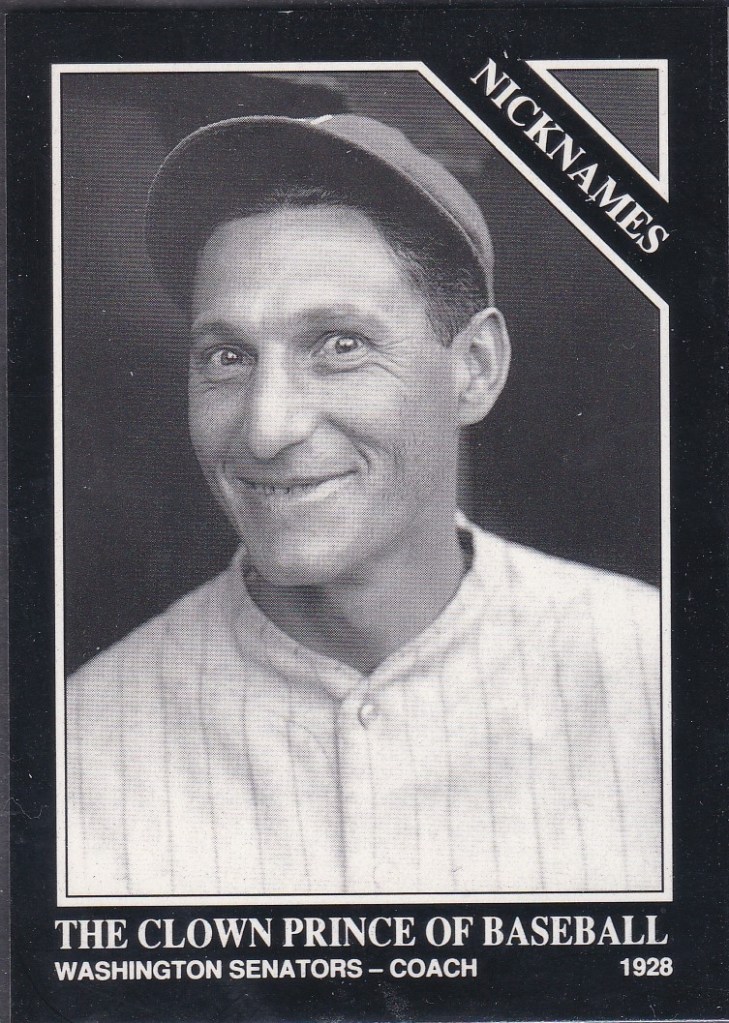
Were it not for the on-the-field comedy routine and he and fellow Senator Nick Altrock developed, however, Schacht likely would be relegated to obscurity, rather than remembered as “the Clown Prince of Baseball.”
An arm injury curtailed Schacht’s pitching career. He became the clowning partnership with Altrock, already several years into his comedy routine, in 1921. The two had a falling out and never spoke to each other after 1927, although they continued their on-field partnership.
From 1922 into 1924, Schacht kept pitching in the minors, gradually turning entirely to coaching and clowning.
According to Ralph Berger’s SABR bio essay, Schacht first tried his hand at entertaining while he was played for a semi-pro team in Walton, N.Y., in 1910 and ’11. Before games, “he would impersonate a famous actor, then a pitcher who was getting hit all over the place and refusing to go to the shower when the manager came out to lift him. The fans loved it” Berger wrote.
Midway through the 1924 championship season, Griffith brought him back as a coach and entertainer, teaming again with Altrock. In the days long before wireless microphones, the dozens of Schacht/Altrock routines of course depended entirely on sight gags featuring outrageous hats, bats, gloves, costumes and other props.
“Altrock and Schacht became the Martin and Lewis of baseball comedy,” Peter M. Gordon wrote in his bio essay of Altrock. “They created a series of pantomimes … including bowling, juggling, golf tricks, rowing boats during rain delays, mocking umpires, and other tricks.”
In his biography of Walter Johnson, Henry W. Thomas wrote that Altrock eventually became jealous of the attention – and laughs — Schacht was getting. This might have led to animosity that developed between them. (Schacht was Johnson’s roommate on the road for seven seasons.)
Altrock and Schacht worked together until Schacht, long retired as a player, was included in the deal that sent Washington’s shortstop/manager Joe Cronin to the Red Sox. Schacht, who was more than adequate as a third-base coach, handled the same role for Boston in 1935 and 1936.
Schacht and Altrock performed at the World Series in 1921 and again beginning in 1927, On the vaudeville circuit in the off-season, they continued as a team through 1934.
By that time, Altrock, 16 years older than Schacht, was 58. Altrock remained a coach for the Senators through 1953, but gradually cut back on the more physical demands of his comedy and never had another partner.
Schacht continued his act alone, eventually performing in 27 World Series through 1952, 18 All-Star games and hundreds of minor league games. During World War II, he performed for the USO in Europe, Asia and Africa, appearing in the ragged top hat and coattails that became his trademark.
After the war, Schacht opened a restaurant in New York City that became popular with celebrities into the 1960s. Its menu included “Dizzy Trout, Connie Mackerel and Pepper Martin Steak.” Dessert choices were “Pie Traynor, Napolean Lajoie and Yogi Berries.”
Schacht published three life stories about his baseball antics, claiming he had been seen by more people than anybody else in baseball history.
His renown was such that he was sought out to observe and comment on a performance by the acrobatic baseball entertainer Jackie Price. Price was no comedian, but perfected dozens of jaw-dropping stunts that astounded the fans who watched in awe. “He’s worth whatever they pay him.” an impressed Schacht said after seeing Price perform.
Despite their estrangement, Schacht spoke kindly of Altrock when his old partner died in 1965. “Nick was a great comedian,” Schacht said. “And we should all remember that he was a fine big league pitcher as well as an exceptional entertainer.”
Schacht was 91 when he died in 1984 in Waterbury, CT.
 Washington baseball history