
Topps began picking all-star rookie teams by position after the 1959 season, recognizing the players chosen on their 1960 cards. For decades, eight position players and two pitchers –a righty and a lefty starter — were selected for recognition on the following season’s cards.
That first team, Topps declared on the cards, was “selected by the youth of America,” but I have found no explanation of that or of the procedure Topps uses to make its picks. Some choices are obvious, but many are not.
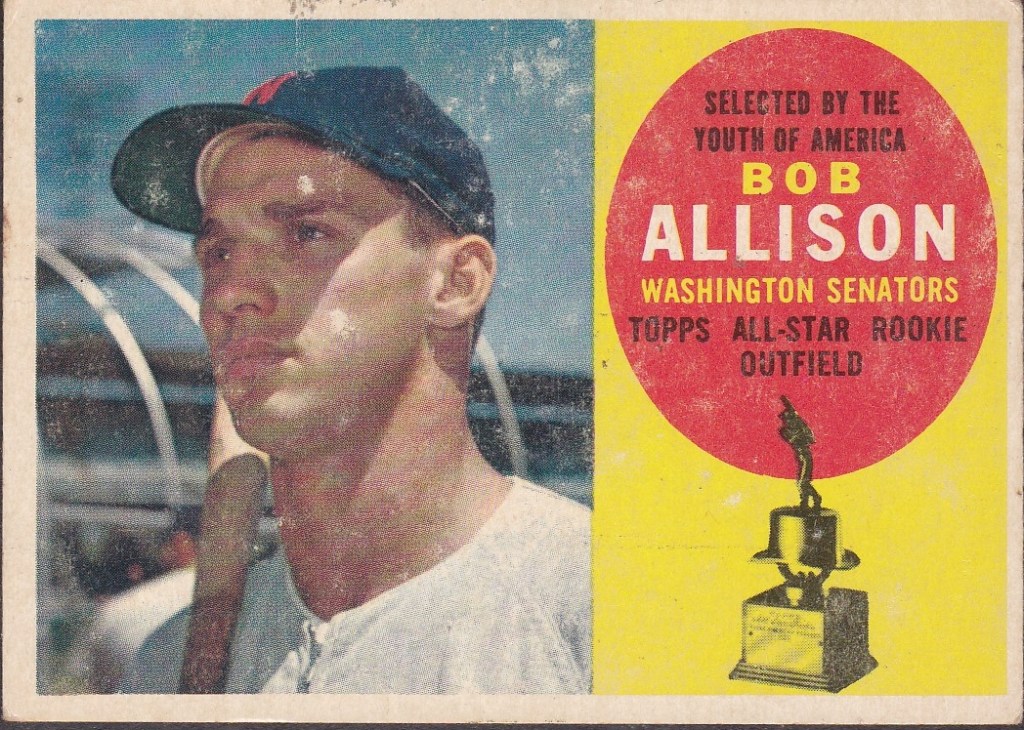
The 1959 American League Rookie of the Year, Bob Allison of the original Senators, was one of the outfielders on that first rookie all-star team, but two other rookies-of-the-year in subsequent seasons (Ken Hubbs in 1962 and Jim Lefebvre in ’65) weren’t even picked as Topps’ all-stars.
Allison moved with the team to Minnesota and had a solid career. Another member of the first rookie all-star squad was outfielder Willie Tasby. In the fall of 1960, he was selected by the replacement Senators in the expansion draft. He played regularly for the ’61 team, but ended up with a negative career bWAR.
Several players who were on rookie all-star teams over the years didn’t get the familiar gold trophy that appeared from 1961 through 1972 on their cards. In collector parlance, those are considered “uncorrected error” cards.
Future Senators’ slugger Frank Howard was voted National League Rookie of the Year as a Dodger in 1960. He made the Topps team in the ’61 set, but didn’t get the trophy on his card.
The same was true of the ’65 card of the Senators’ Mike Brumley. He was the regular catcher on the ’64 team, starting 112 games and hitting .244. The back of his card acknowledged his selection as an all-star rookie. Bob Chance, obtained by Washington in a trade from Cleveland, was the first baseman on that ’64 rookie team. He has a gold trophy on his card, which lists him as a Senator.
Off and on starting in 1973, Topps replaced the trophy with a gold cup, which appears on such famous all-star rookie cards as the one for Ken Griffey Jr. in 1989.
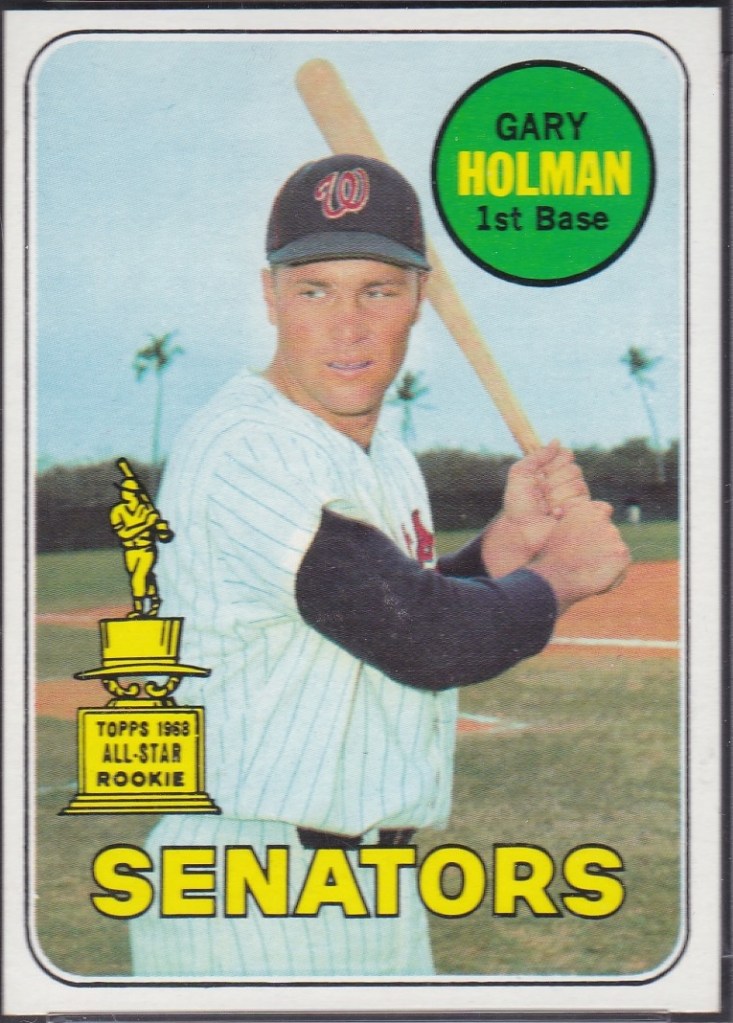
Despite what BR Bullpen and other sites say, every year, without fail, Topps has anointed a player at each fielding position, no matter how few or weak the choices are. Unable to decide, Topps in three years picked two players for one spot: two right-handed pitchers in 1967 and 1985, and two second basemen in 1968. (One of those, Dave Nelson, ended up on the last Senators’ team.) In 1986, Topps named four rookie outfielders to its all-star team.
Nats fans can’t be blamed if they don’t recall Gary Holman, who played sparingly in 1968 and even less in ’69. Yet he was, presumably by default, deemed the rookie all-star first baseman from ’68. He had started just three games there all season and was a defensive replacement at first in 30 other games.
More deserving of a spot of the ’68 team was Senators’ center-fielder Del Unser, if only by the anemic offensive standards of that season. Rookie Unser hit just .230 and had a negative 1.5 bWAR for a last place team in the Year of the Pitcher. Yet he went on to have a decent 15-year career, capped with an outstanding post-season run with the Phillies in 1980.
Tim Cullen was hardly the regular shortstop for the 1967 Senators, but he was the all-star rookie there in the Topps ’68 set. Cullen was a utility infielder, playing second and third. But he did start 69 games at short during regular Ed Brinkman’s worst year at bat and service in the National Guard. Cullen hit .236 to Brinkman’s .188.
Two other players who ended up playing for the Senators (Ron Hansen in 1960 for the Orioles and Bernie Allen in 1962 for the Twins) were all-star rookies.
The Senators were long gone before Topps named its first designated hitter – Eddie Murray in 1977 – as a rookie all-star. At the time, it was a one-off. Murray was mostly a DH, but appeared in the field in 42 games on the way to becoming the A.L. Rookie of the Year. It would be nearly 20 years before he was primarily a DH again.
Indeed, it wasn’t until the 2010s that Topps began annually including a relief pitcher and a DH on its rookie teams.
Once D.C. inherited the Expos in 2005, Washington was back in the rookie all-star mix. Although the voting procedure has never been made clear, third-baseman Ryan Zimmerman was a “unanimous selection” in 2006, as were others starting in 2005. Dan Uggla, who later played briefly for the Nationals, was the second baseman on that team.
John Lannan, 9-15 for a team that lost 102 games, was the right-handed pitcher on the 2008 rookie team.
A consensus number-one draft pick, Stephen Strasburg made just 12 starts in his debut season. That was enough, however, to make him the right-handed pitcher on the 2010 Topps Rookie All-Star team. Danny Espinosa followed him on the 2011 team at second base.
Of course, N.L. Rookie-of-the-Year Bryce Harper was on the 2012 team. Weirdly, utility infielder Steve Lombardozzi joined him as the second baseman. He did start 43 games there, hitting .273.
Trea Turner was the shortstop on the 2016 rookie all-star team. Juan Soto followed as an outfielder for his 2018 rookie season, as did Victor Robles for 2019.
The last National to make the cut for the Topps team was understandable, but a bit sad: Longtime minor leaguer Joey Meneses gave fans some hope after the Soto trade with his unexpected offensive run in August and September 2022. It earned him a spot as the first baseman in the 2023 Topps all-star rookie set, but like many others named to these teams over the years, his performance was something he would not repeat.
Two other former rookie all-stars were later with the Nationals: Ben Revere was an outfielder with the Twins on the 2011 team, but had the worst season of his career with the 2016 Nats. Paul DeJong of the Cardinals was a 2017 rookie all-star at shortstop before playing an injury-shortened season for Washington in 2025.
Longtime expansion team third-baseman Ken McMullen, along with Al Weis of the White Sox and Pedro Gonzalez of the Yankees, shared a 1963 rookie card with Pete Rose. Weis also joined Rose on the Topps All-Star Rookie team in the ’64 set. Both got the gold trophy on their 1964 cards. The similarities, however, end there.
Anyone who has either the ’63 or ’64 Rose card, especially if it’s slabbed and graded, probably knows both are among the most valuable cards from the ’60s. It’s why acquiring a complete player set of Weis or McMullen is so challenging.
 Washington baseball history