
On March 27, 2025, MacKenzie Gore equaled an opening day record set by Hall-of-Famer Bob Gibson in 1967. Gore, an all-star later that season, struck out 13 Phillies without walking anyone or allowing any runs. Sadly, he won’t be doing anything like that for the 2026 Nationals after his January 2026 trade to the Texas Rangers for five prospects.
In the fall 2024 edition of SABR’s Baseball Research Journal, the eminent SABR author and researcher Herm Krabbenhoft unveiled a new category of achievement: the “Pitcher’s Cycle.” Gore’s opening day start made the list.
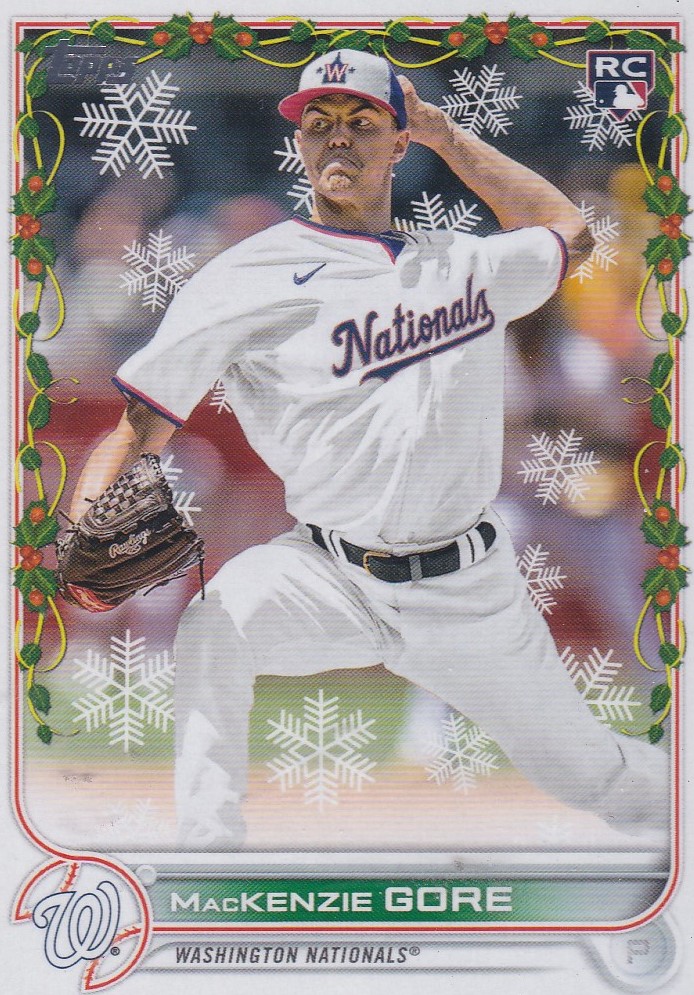
Krabbenhoft came up with an accomplishment for pitchers that has been, at least until recently, nearly equivalent to a batter’s cycle defined thus: A pitcher (in all but six instances, a starter) strikes out one hitter he faces in each position in the batting order. That’s a minimum of nine strikeouts and covers substitutions in a hitting slot.
According to Dr. Krabbenhoft’s research updated several times on the SABR-L message list, Gore became the 498th to achieve a Pitcher’s Cycle. By season’s end, the number has grown to 503. That’s average of slightly less than four per season since 1893.
The traditional baseball cycle, of course, is when a batter hit a single, double, triple and home run in a game, in any particular order. Players at every defensive position and designated hitter, except pitcher, have done it — 351 times in all, an average of fewer than three times a season. (Shohei Ohtani has hit for the cycle as a designated hitter but not in the two games so far that he achieved a Pitcher’s Cycle.)
On April 21, 2025, in New York, Tyler McGill of the Mets achieved cycle no. 499, also against the Phillies, striking out 10 in 5.1 innings. Cincinnati’s Hunter Greene then recorded the 500th regular-season Pitcher’s Cycle in MLB history in the Reds game on May 2 against the Nationals at Great American Ball Park. Greene struck out 12 over his six innings pitched.
In contrast, just two batters – Carson Kelly of the Cubs and Byron Buxton of the Twins –hit for the cycle in 2025. Four players had cycles in 2024.
With the massive increase in strikeouts in the past 25 years, however, pitching Cycles have become less rare. Seventy seasons passed before Tom Seaver became the 100th pitcher to achieve a cycle, but just 26 years for John Smoltz to pitch no. 200 in 1996. Fourteen years later, a 300th was pitched; nine years after that, no. 400. Now in the sixth season since then, Pitcher’s Cycle no. 500 is reached. (Krabbenhoft’s figures do not include the Negro Leagues recognized by MLB.)
Perhaps the prevalence of strikeouts will recede. The strike zone has been reduced before. Otherwise, the Krabbenhoft standard might become too easy to achieve.
As Krabbenhoft wrote in Baseball Research Journal, “Pitcher’s Cycles have become more frequent than Batter’s Cycles, perhaps dimming the luster of the PC.” In recognizing this, he also made note that an outstanding performance such as Max Scherzer’s 20 strikeout game in 2016 did not qualify for a pitcher’s cycle because he didn’t fan the Tigers’ Victor Martinez.
As is, a pitcher has to retire nine batters on strikes to have a cycle. That number could be paired with allowing no earned runs and/or issuing no walks, for example. Those, just as a strikeout, are in the pitcher’s control alone in preventing runners on base.
Applying changes retroactively would reduce the number of Pitcher’s Cycles already achieved and the number going forward. MLB did something similar with the definition of no-hitters. Various advanced metrics also have been tweaked since they came into use.
In any case, Gore became the 14th National to pitch a cycle. (Just two Nationals’ batters have hit for the cycle.) Gore would have achieved a cycle if either not issuing a walk or allowing an earned run were part of the critieria.
Bob Gibson in his 1967 start didn’t fan all nine spots in the batting order.
The Nationals’ pitcher who earned the most recent one before Gore was Max Scherzer in 2019. And yes, his was no. 400.
 Washington baseball history