
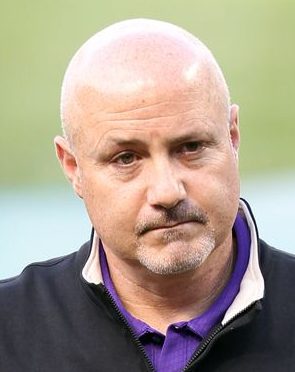
On July 6, 2025, the Washington Nationas announced that Mike Rizzo had been fired after nearly 17 seasons as the head of baseball operations for the Washington Nationals. His teams improved from 59 wins in 2009, his first year at the helm after three seasons as an assistant GM, to a team-record 98 victories and a division title in 2012.
Rizzo teams went on the win three more division titles by 2017 and, famously, won the World Series in 2019. The Covid-shortened season prevented the Nationals from celebrating their championship in front of fans or reaping the benefits in attendance. With a long-in-the-tooth roster and depleted farm system, Rizzo went into full rebuild mode in 2021 with as yet no sign of results on the field.
So how should the Rizzo era be judged?
Rizzo became the Nationals’ interim general manager in March 2009 after Jim Bowden resigned amid a federal investigation over whether baseball scouts and executives accepted kickbacks from bonuses that were originally promised to Latin American signees. Bowden said he had done nothing wrong and was never charged.
The Nationals had recently been embarrassed by the signing of a supposedly 16-year-old Dominican prospect known as Esmailyn González, who was discovered to have understated his age by four years and used a fake name before receiving a $1.4 million signing bonus.
Twenty of the 25 players on the 2012 roster were drafted or acquired under Rizzo. The most prominent contributors were first baseman Adam LaRoche and outfielder Jayson Werth, signed as free agents, pitcher Gio Gonzalez and outfielder/first baseman Michael Morse, acquired in trades.
After signing Max Scherzer before the 2014 season, the Nationals won three of the next four N.L. Eastern Division titles. Although the team lost in the first round of the playoffs each time, you can’t lose in the post-season without getting there.
So after missing the playoffs in 2018, Rizzo made sure he had added parts before and during the 2019 season, which of course ended in a World Series victory. Kurt Suzuki was acquired, as he had been in 2012, to shore up the catching. So was Yan Gomes. Howie Kendrick came back from a serious injury. Asdrubal Cabrara, who contributed in 2014, was picked up on waivers in early August. Daniel Hudson was added to the bullpen.
Giving Rizzo less than an “A” grade for his 2009 to 2019 tenure would be ignoring the results. Not all of his or any general manager’s trades or free agent signings are winners. Some are clearly good and some are so-so. Rizzo seems to have avoided trades that ended up as short-term disasters. The trade that acquired Trea Turner, for example, as well as pitcher Joe Ross, was unequivocally good for the Nats. Outfielder Steven Sousa Jr. was all it cost.
Rizzo can’t really be given too much credit for using the No. 1 picks in the draft on consensus choices Stephen Strasburg in 2009 and Bryce Harper in 2010, as crucial as they were. Both got record signing bonuses.
One reason Rizzo kept the team winning was the Lerner ownership family’s willingness to support a payroll that ranked in the top10 in all but one season from 2014 to 2021. Another was Rizzo’s willingness to trade prospects for players who would have an immediate impact.
Future Cy Young Award winner Robbie Ray was traded to the Tigers for pitcher Doug Fister, who helped the Nationals for one season. Lucas Giolito, a first-round draft pick who continues to have a decent career, was traded for outfielder Adam Eaton, who helped the Nats win the championship in 2019 but was gone soon after. Those are prime examples of the long-term risk for short-term gains. Ray will still be in the majors next season as will Giolito. The two pitchers who were traded with Giolito were still in the majors this past season, too.
By 2019, the Nationals farm system ranked near the bottom in terms of major prospects. Recognizing this and knowing that the Nationals lineup was aging fast, Rizzo began a 2021 trade-deadline dismantling of what was left of the World Series champs. Although the team was hovering around .500, Scherzer was due to become a free agent. Clearly, he was going to be traded to a contender. The shock was that Turner, still under team control through 2022, was sent to the Dodgers with Scherzer.
In quick succession, Rizzo traded Gomes and regular second baseman Josh Harrison to the Athletics. Backup catcher Drew Millas was the only return worth mentioning. Then Kyle Schwarber, who had just set a team record for homers in a month, was sent to Boston for a pitcher who didn’t pan out. Daniel Hudson was traded to the Padres for Mason Thompson, whose career was derailed by arm trouble. Brad Hand went to the Blue Jays for backup catcher Riley Adams, another Millas. A fading Jon Lester at least brought Lane Thomas in return.
At first, it looked like the Scherzer/Turner swap might work out immediately. Josiah Gray, an all-star pitcher in 2022, and catcher Keibert Ruiz were the return. (You have to wonder why Rizzo settled for two more catchers in other swaps.) Of course, injuries to both Gray and Ruiz have cast doubt on their futures. Adams and Millas have proved to be no more than backups so far.
After falling to last place in 2021 and with 2022 not looking much better, Rizzo pulled off a trade that even now seems to have been the best he could have done under the circumstances: Superstar Juan Soto, represented by agent Scott Boros, turned down a lucrative long-term offer from the Nationals. With a year left before he reached free agency, Soto was traded along with first baseman Josh Bell to San Diego. The return was massive: Lefty MacKenzie Gore, shortstop CJ Abrams, outfielder James Wood (all three already all-stars), outfielder Robert Hassell III and top pitcher prospect Jarlin Susana. First baseman Luke Voit was a throw-in.
Still, after improving from a disastrous 55-107 in 2022, the Nationals stalled at 71 wins in 2023 and 2024, then fell back to 66-96 in 2025 – last place in the N.L. East for the fifth time in six seasons, the worst team in the N.L. aside from the horrible Rockies.
Ultimately, Rizzo’s performance since 2019 must be graded as no better than “C-” unless the Nats make an unlikely major rebound in 2026 with players he acquired.
General managers are almost always involved in free-agent signings, if not always with the dollar amounts. The Nationals and Rizzo get credit for signing Werth to give the franchise credibility that it intended to build a winner. The same holds true about sustaining success in signing Scherzer to a seven-year deal.
The seven-year, $245-million, contract given to Strasburg after the 2019 season is another matter. How much Rizzo had to do with this in terms of length and dollars is unknown. What is known is Boros, Strasburg’s agent, had a working relationship with Ted Lerner, so Rizzo might well have been only tangentially involved. Obviously, Strasburg’s injuries ended his career. His contract was guaranteed and the team had no insurance coverage on it. Ouch.
Let’s hope the Strasburg deal has not made ownership gun-shy about long contracts or sustaining a payroll that isn’t in the bottom third of MLB teams, where’s it’s been lately. Rather than go after a bigger free agent in the fall of 2024, for example, the Nationals signed low-priced first baseman Nathaniel Lowe.
Rizzo’s firing came as Lowe’s average dropped below .220 and his power numbers had declined. After Lowe was designated for assignment, Daylen Lile was given the opportunity to play every day at DH and became N.L. player of the month in September. That might not have happened if Rizzo had still been in charge.
As respected baseball columnist Ken Rosenthal wrote the weekend Rizzo was fired, shortly before the baseball draft:
“The Nationals’ failures in player development, as well as in amateur and international scouting, go back more than a decade. Rizzo made changes to scouting and player development at the end of 2023. But they might have been too little, too late…. Firing a losing president of baseball operations is defensible as long as ownership has a plan. When ownership makes such a move just before one of the biggest transactional days on the calendar, it’s fair to question what that plan might be.”
In rebuild mode for four and half seasons, team ownership must give the new head of baseball operations Paul Toboni enough payroll flexibility to sign a top free agent, if not now, soon. If Toboni must trade Gore and/or Abrams, he better get a big haul of major-league and major-league-ready talent in return. Nationals fans deserve better than the past five years.
 Washington baseball history