
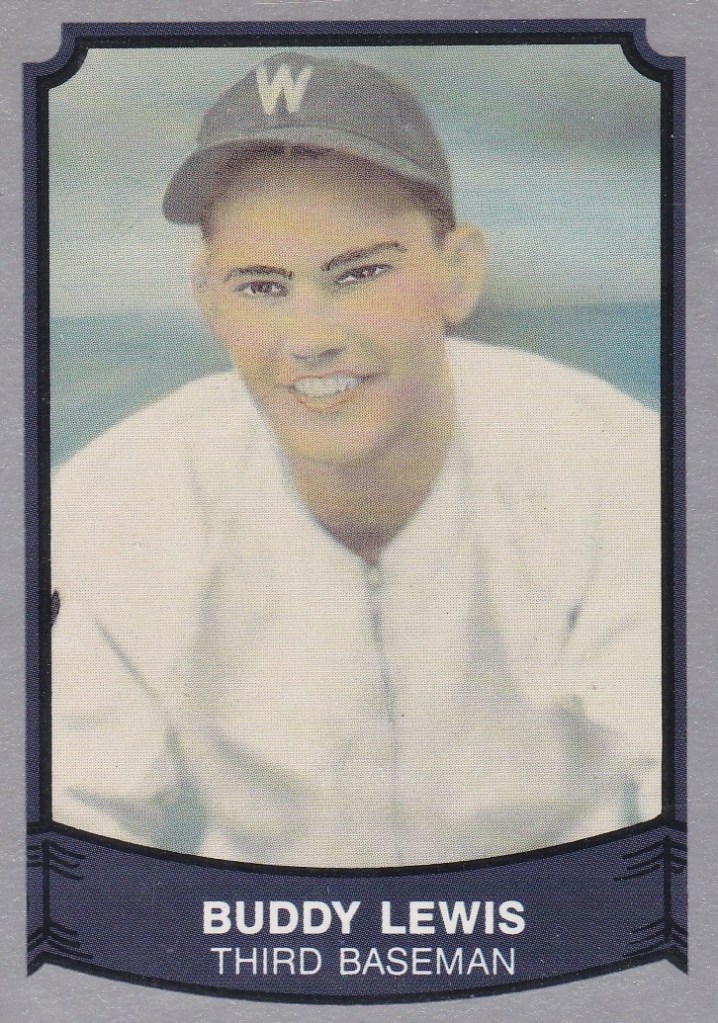
John “Buddy” Lewis, the Senators’ All-Star third baseman in the late 1930s, was the fourth major leaguer to reach 1,000 hit before his 25th birthday. The first three who reached the same milestone before Lewis and the two since are all in the Hall of Fame.*
Because he missed three and half seasons in his prime to become a decorated pilot in World War II, Lewis did not make it into Cooperstown. But he did hit .297 for his career, all with Washington. He became the regular third baseman at age 19 in 1936, and went on to score more than 100 runs four times.
Lewis played in all 156 Senators games in 1937 and led the league with 668 at-bats. The left-hand batter made the All-Star team in 1938, a year when he scored 122 runs and drove in 91, hitting in the no. 2 hole.
Before Lewis entered the military after the 1941 season, his career batting average through six full seasons stood at .301, with three years of on-base percentages of .386, .393 and .402, a stat that didn’t garner much attention in that era.
His 15 hits in four consecutive games, July 25-28, 1937, stood as the American League record until Julio Rodriquez of the Mariners set a new major league mark of 17 hits in four straight games in 2023. The previous National League and MLB mark was 16, set by Milt Stock of Brooklyn, then known as the Robins, in 1925.
Often a liability in the field, Lewis in August 1937 tied the post-1900 record of four errors in a game by a third-baseman. A quote attributed to him on his Baseball-Reference Bullpen Page: “It got so that every time I threw to first, the right-field bleacher fans would duck.” He eventually moved to right field.
As an Army Air Force pilot, Lewis flew a C-47 cargo plane in 368 missions over the Himalayan “Hump” from India to occupied Burma. Six hundred American planes were lost and 1,600 GIs died during similar missions. Lewis was awarded the Distinguished Flying Cross three times and other medals before being discharged in July 1945.
According to the comprehensive SABR Bio Project essay by Wayne Corbett, as soon as Lewis was mustered out at Fort Bragg in North Carolina, he took a train to D.C. and was back in the Washington outfield six days later.
The Tigers, Senators and Yankees were in a surprising pennant fight when Lewis rejoined the team. The Yankees soon fell out of the race, but the Nats nipped at the Tigers’ heels the rest of the way. With Lewis providing a needed offensive jolt, the Nats soon put together the first of two seven-game winning streaks.
Lewis hit .333 in 69 games with a .423 OBP. The Nats ended the season with a chance to forge a tie for first if the Tigers were swept in a final-double header a few days later against St. Louis. Alas, another returning veteran – slugger Hank Greenberg – hit a ninth-inning grand slam in the first game, clinching the pennant for Detroit. The second game wasn’t needed, and Washington ended the season 1.5 games behind.
In 1946, Lewis had a solid season: .292 with a .357 OBP. A highlight was a 17-game hitting streak. He was off to a similar start in 1947 and was named a starter in the A.L.’s All-Star outfield along with Joe DiMaggio and Ted Williams. After he injured a hip, he slumped and finished at a career low .261 average. He also no longer exhibited the aggressiveness and outgoing nature he had before the war. Today, he might be diagnosed as suffering from post-traumatic stress.
In any case, although just 31, he decided to retire. “I had changed so much that baseball didn’t mean as much to me as it did before the war,” he told author Rick Van Blair for a 1992 article in Sports Collectors Digest. Lewis left with his career average still over .300.
After a season away, running the car dealership he owned in his native Gastonia, N.C., Lewis was persuaded by Clark Griffith to return in 1949. The rust showed. He was injured in May and ended with a .245 average on a last-place team with the worst record of any under Griffith’s ownership. This time, Lewis retired from the majors for good.
Lewis got married in 1951 and had two daughters and a son. He became active in American Legion baseball as an administrator and coach.
Along with his teammate and close friend Cecil Travis, whose war injuries shortened his own career, Buddy Lewis was a mainstay for Washington teams that often were competitive in the mid- to late-1930 and again in 1945-46.
The esteemed sabermetric guru Bill James rates Travis and Lewis high on his short list of players who well might have made the Hall of Fame, were it not for the time they lost to the war.
Lewis lived to be 94 in Gastonia, where he died on Feb. 18, 2011.
*The other five are Ty Cobb, Freddie Lindstrom, Mel Ott, Al Kaline and Robin Yount. Mike Trout, by the way, got his hit no. 1,000 the day of he turned 25.
 Washington baseball history