
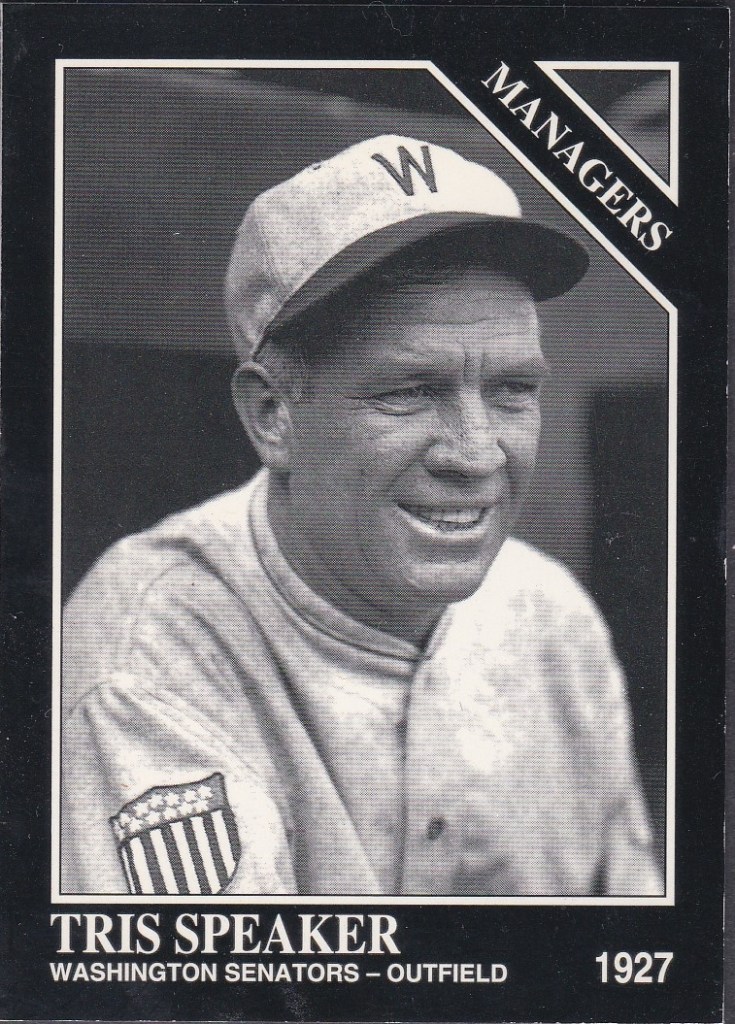
Tris Speaker, the Grey Eagle, was among the second group of baseball immortals elected in January 1937 to the Hall of Fame in time for the first formal induction ceremony. He was voted in along with Cy Young and Nap Lajoie, joining the five original inductees —Ty Cobb, Babe Ruth, Honus Wagner, Christy Mathewson and Walter Johnson.
Most closely associated with Boston and Cleveland, Speaker spent a season – 1927, his last as a regular – with the Nats. Clark Griffith signed Speaker in late January for $35,000, which was the highest salary the Old Fox had ever paid any player. (Twenty-five years later, Griffith grudgingly paid Mickey Vernon just $30,000 the year after Vernon won a batting title.)
That season, while below Speaker’s incredible highs of his younger years, was none too shabby.
Speaker helped lead Washington to a third-place finish with 85 wins. He hit .327 with a .395 on-base percentage, 43 doubles and 73 runs batted in. His 3.7 WAR was second only to Goose Goslin among the team’s offensive players. He struck out just eight times in 141 games. At age 39, he still played mostly in centerfield, where he was long recognized as the best in the game.
Speaker had been replaced as Cleveland’s manager. Nearing his 39th birthday, he was allowed to sign with another team. He started off slowly (by his standards) in Washington and didn’t raise his average to .300 until early May, but by mid-August, he was up to .320 as the Nats were clinging to second place behind the Yankees.
Unfortunately, Speaker persuaded manager Bucky Harris that the 30-year-old Boston shortstop Topper Rigney would be better at short than the younger Buddy Myer, who was less experienced there. Harris got Griffith to trade Myer for Rigney, a move that Griffith later deemed one of the worst he ever made. Rigney lasted just 45 games with Washington. Two seasons later, Griffith had to give Boston five players to bring back Myer, a future batting champ and fixture in D.C. for the next decade.
On May 17, 1925, against Washington, Speaker had become the fifth major leaguer to reach 3,000 hits. He did it with his third hit off Tom Zachary in Cleveland, in a game the Nats won, 2-1. Two seasons later, Speaker would be a teammate of Zachary when the Nats’ lefty famously yielded Babe Ruth’s 60th home run.
Speaker remains the all-time leader in doubles with 792. His lifetime batting average was .345, with a .428 OBP. He created his own 50-50 club in 1912 with Boston: 53 doubles and 52 stolen bases. And, in that dead-ball era season, his 10 home runs led the A.L. His .462 OBP was also tops, as was his 10.2 WAR (retrospectively, of course).
Born right-handed, Speaker had to learn to throw left-handed after he was thrown from a horse at age 10, breaking his colla rbone and right arm. Despite that, he is all-time leader in assists and double plays by a centerfielder.
In May 1927, when Washington visited Cleveland for the first time that season, fans presented Speaker with many gifts in a pre-game ceremony and gave him a loud and long, standing, ovation when he came to bat.
After a part-time role with Connie Mack’s Athletics in 1928, Speaker became player-manager of the International League’s Newark Bears, where he hit .419 in limited duty on the field in 1930, his last as a player.
Later, in a management role with Cleveland, he helped Larry Doby adjust to being the first Black player in the American League in 1947.
Speaker was 70 when he died on December 8, 1958.
 Washington baseball history