
Second baseman Don Blasingame was a veteran who already had been an all-star and had played in a World Series when he was traded to the Senators in 1963. He was a solid fielder but never much at the plate – a spray hitter without much power.
Yet when he retired, he held an impressive major league record: He had hit into the fewest double plays per times up for anybody with a substantial amount of playing time. He has since dropped to no. 4 all-time.
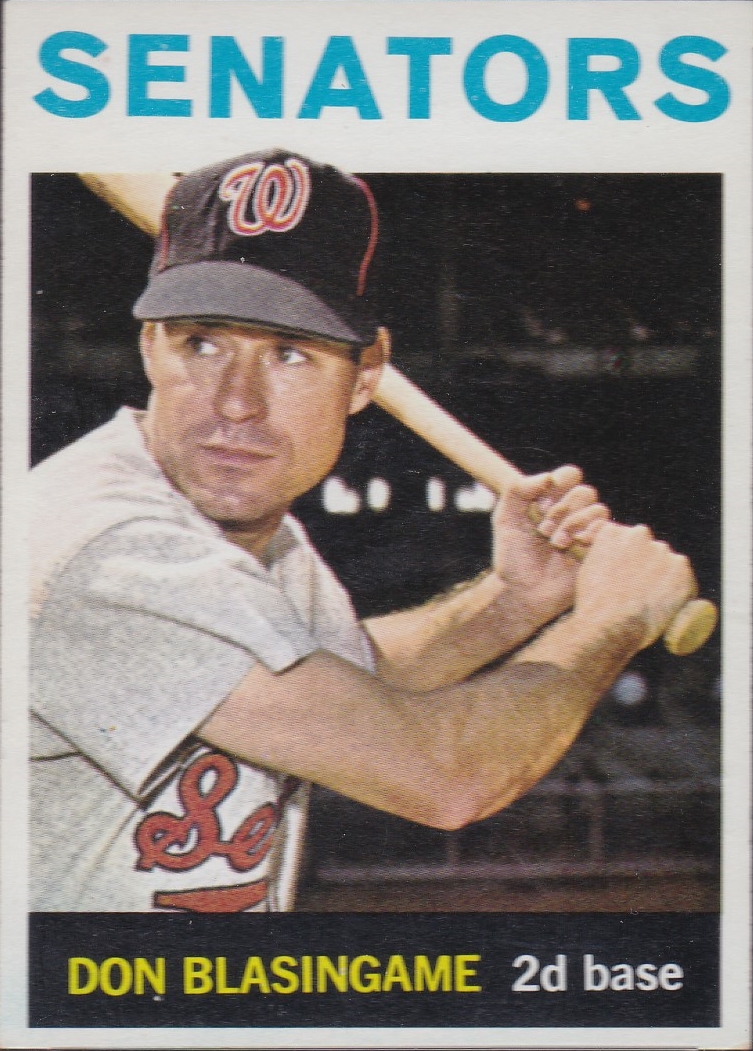
Blasingame had a 12-year MLB career with 5,938 plate appearances, but grounded into just 43 double plays — one every 138 times up.
Don Buford, who spent 10 seasons with the White Sox and Orioles through 1972, hit into just 33 double plays – one every 157 plate appearances. That’s the lowest percentage for players with 5,000 or more times up, or at least since official statistics have been kept; 1933 in the N.L. and 1939 in the A.L.
After eight full seasons in the N.L., Blasingame played parts of four seasons in Washington. As a regular in 1964, he got up 556 times and grounded into just one double play. In 1,506 plate appearance with the expansion team, he hit into just four twin killings. He may not have lived up to his early career nickname (“the Blazer”), but he certainly couldn’t be called a rally killer. For his career, he walked more than he struck out, so he usually made contact.
Since Blasingame retired, two players with 5,000 or more plate appearances, other than Buford, have passed him. Brett Butler is no. 2 behind Buford. Matt Carpenter of the Cardinals passed Blasingame in 2018 when he played 151 games without a GIDP.
Centerfielder Butler, who debuted in 1981 and played through 1997, grounded into double plays less frequently than anybody with more than 6,000 plate appearances. He, like Buford and Blasingame, made just one all-star team and played in the World Series, but he was more of a star, leading the league in triples four times and compiling a 49.7 WAR, as per Baseball Reference. He had a .377 on-base percentage over 17 seasons. Butler also walked more than he struck out. Fast afoot, he grounded into just 62 double plays in 9,545 plate appearances — once every 154 times at the plate.
An excellent leadoff hitter, bunter and prolific base stealer, Butler compares favorably with Hall of Famer Richie Ashburn.
Four players, according to Baseball Almanac, have appeared in 150 or more games in a season and never grounded into a double play. Hall of Famer Craig Biggio leads the list. In 1997, he played in all 162 games with the Astros without short-circuiting a rally that way.
The others never doubled up were Augie Galen (1935 Cubs in 154 games), Dick McAuliffe (1968 Tigers, 151 games) and Carpenter (2018 Cardinals, 156). That season moved Carpenter ahead of Blasingame. Carpenter, still active as of 2024, has grounded into double plays just once every 144 plate appearances.
Ashburn hit into the fewest GIDPs in a record six seasons (1951 to 1954, 1958 and 1960) in N.L. Ichiro Suzuki, headed for the Hall, hit into the fewest in the A.L. four times between 2001 and 2006.
Among those with significant playing time but far fewer than 5,000 times up, outfielder Roger Repoz of the Angels is an outlier, a power hitter and middle-of-the-order type. In 2,471 plate appearances over nine seasons, he hit into just 14 double plays. That’s once 176.5 times at the plate. From June 1967 to May 1970 – 347 games and 1,018 plate appearance – he never hit into one. Both figures are believed to be all-time records, despite his .224 lifetime batting average.
Among those with about as many plate appearances, according to Joe Poznanski in a 2017 Medium post, only Kaz Matsui, primarily a lead-off hitter, avoided GIDPs better than Repoz. Matsui hit into once in every 183 plate appearances, 14 double-play grounder in 2,555 plate appearances.
The most prolific rally killer by hitting into ground-ball double plays in a season, as calculated by Posnanski, was Nationals catcher Ivan Rodriguez, a Hall of Famer. He was the Nats’ primary backstop in 2010, his last as a regular. That season, based on his propensity for grounding into two outs when such an opportunity presented itself, Pudge did so once every 3.5 times he came up with a runner (or runners) on base and none or one out – 25 GIDPs in 88 chances. Ouch.
The left-hand batting Blasingame had decent speed. He stole 20 bases twice for St. Louis in 1957 and ’58 at a time when steals were out of vogue. His total was third in the N.L. in 1957. He didn’t run much for the Nats, however – 18 in four seasons, and he was caught 12 times.
Ed Brinkman, the Senators’ slick fielding shortstop, credited Blasingame with teaching him the finer points of fielding during their time together in Washington. By sabermetric standards, applied retrospectively, Blasingame was the top fielding second baseman in the N.L. in 1956, ’57 and ’59.
When his big league career ended in 1966, Blasingame played three seasons in Japan before becoming a coach and manager there. A son, Kent, played several seasons in the minors before becoming a scout for the Rockies based in Japan, where he had learned Japanese while living with his father and family.
Blasingame died of a fatal heart attack in 2005 at age 73 after playing a round of golf in Arizona. You can read Charles F. Faber’s account of Blasingame’s life, part of the Bio Project at SABR.org.
A version of this appeared in the Dec. 14, 2024, edition of Here’s the Pitch, the daily online post of the Internet Baseball Writers Association.
 Washington baseball history