
The game between the Senators and Red Sox in Washington on Sept. 21, 1946, was memorable for two reasons unrelated to the outcome: It pushed Griffith Stadium’s attendance over one million for the first (and only) time and it turned into a melancholy tribute to the dying Walter Johnson.
Knowing that a Saturday crowd coming to see the team that already had clinched the American League pennant would on its own be enough, team owner Clark Griffith had bigger ideas. He announced more than a week before the game that a lucky fan would be awarded a $1,000 prize (equal to nearly $17,000 today). The winner would be randomly selected from the ticket stubs of all those in attendance. So it would not necessarily be the actual holder of ticket number one million, even if that could have been determined. All the reserve seats for the game quickly sold out.
Aside from the promotion and the planned in-game ceremony to pick the winner, Griffith had another goal in mind: He intended to honor his greatest player by presenting the gravely ill Walter Johnson with a $5,000 donation to help with The Big Train’s medical expenses.
Johnson had been diagnosed with an inoperable brain tumor and had been hospitalized since April. In addition to picking a lucky fan and drawing attention to the team’s attendance milestone, Griffith wanted a huge throng on hand to honor Washington’s most beloved sports figure of all time. A capacity crowd of 24,386 was on hand.
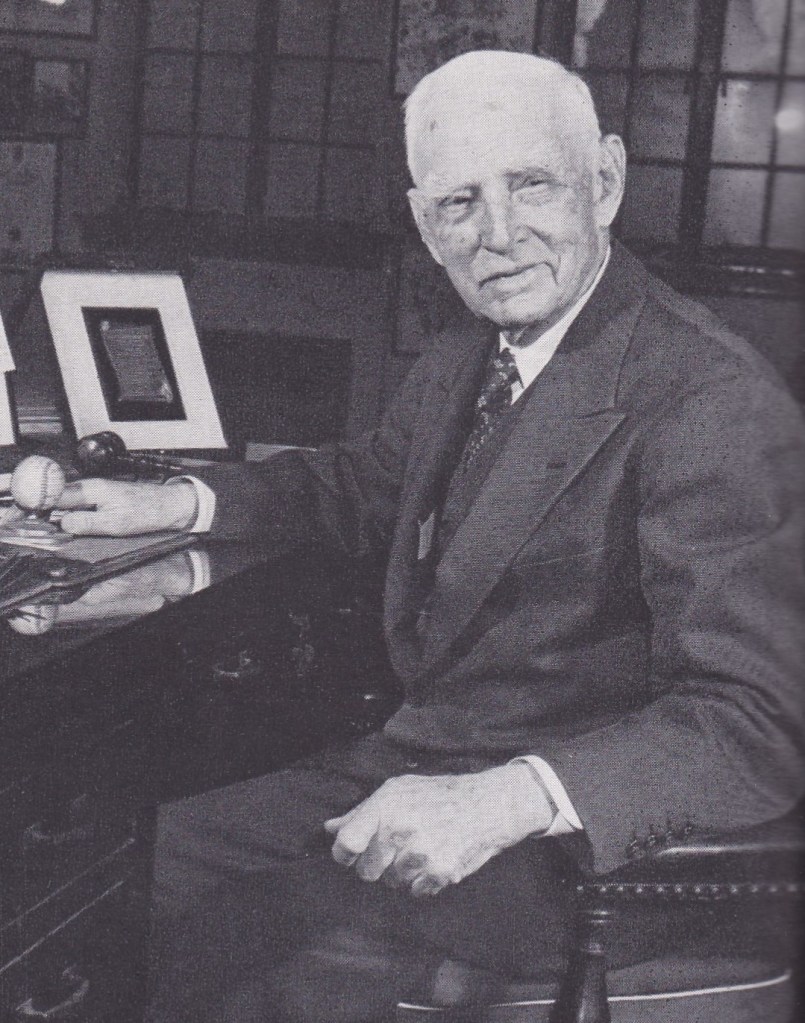
““Tom Yawkey, owner of the Red Sox, and I have agreed to donate $5,000 from the receipts of this game to Walter,” Griffith told reporters on Sept. 9. “We want to make it an epochal occasion”… in tribute to “the man who had a lot to do with making baseball big league in Washington.”
To accommodate more fans, the bleachers used for football games were installed in front of the left-field stands, the Evening Star reported, “whacking 30 feet off the distance to home run territory.” A right-hand hitter now could circle the bases with a clout of just over 375 feet, instead of 405, in the stadium that for decades yielded the fewest home runs every season.
Washington’s Bobo Newsom and Boston 25-game winner Dave Ferriss engaged in a pitching duel through the first seven innings, with the Senators up, 2-1. A victory by Ferris would have tied him with Grover Cleveland Alexander’s 47 wins as the most ever in a pitcher’s first two seasons, but it was not to be. The Nats knocked out Ferriss in the eighth, taking a 5-3 lead.
In the ninth, however, the normally sure-handed Mickey Vernon booted a grounder to help the Sox tie the game. Boston won it in the 11th with the help of a homer into the newly shortened left-field stands. It was the 100th win for the Red Sox. Coincidentally, a “Mickey Vernon Day” was scheduled for the home finale the next afternoon for the soon-to-be A.L. batting champion.
In the middle of the seventh inning, several boxes of ticket stubs were brought onto the field and dumped onto a tarpaulin large enough to hold them. Red Sox slugger Ted Williams was blindfolded and asked to pick one. Fans were hanging on anxiously to their green rain checks as the ticket number was announced.
The winner was Earl Crain, who worked in maintenance at the National Gallery of Art and who was at the game with his wife. He had bought the tickets the day before from friends who couldn’t attend because it had been switched from an afternoon to a night game. On the field, Crain accepted the $1,000 bond from Griffith as Williams and Nats’ radio voice Arch McDonald looked on. The lucky Mr. Crain was due at work for at midnight for an overnight shift.
Later in the same ceremony, Johnson’s son, Eddie, accepted a $5,000 bond on his father’s behalf. Griffith, overcome with emotion discussing Johnson’s illness, handed the microphone to McDonald. The money provided by Griffith and Yawkey was matched with another $5,000 from an anonymous donor.
Henry W. Thomas, Johnson’s grandson and author of his definitive biography, wrote that the donor could have been George M. Weiss, soon to become general manager of the Yankees and later the first president of the Mets. Eddie Johnson, Thomas’s uncle, recalled that as the medical bills piled up, he asked the ailing Walter if the family should seek a bank loan. The elder Johnson told Eddie “to contact Weiss, who had never repaid Johnson’s investment many years earlier in the New Haven ball club,” Thomas wrote.
In the early 1920s, Weiss had borrowed $5,000 to purchase the New Haven team in the Eastern League. It seems at least likely some of that loan might have come from Walter Johnson, thus his death bed request that his son contact Weiss.
Surely, the $10,000 helped, but extended hospital stays in the days before hospice care could be ruinous to all but the wealthiest people. Griffith himself began to cover the bills “until eventually they were directed to him,” Thomas wrote. Longtime Griffith scout Joe Engel also offered to do what he could to help the Johnson family.
At the end of the between-innings ceremony, the capacity crowd stood to observe a moment of silence for the greatest player ever to wear a Washington uniform.
Griffith, by now 77 years old, continued to visit Johnson daily, always bringing a single red rose and talking about their shared past. Griffith had taken enough dirt from the mound on which Johnson had pitched to make a garden bed. “Anything enriched by Walter’s sweat is semi-sacred,” Griffith told the doctor, as recounted by Thomas. “Those roses are from that bed.”
Surrounded by family, Walter Johnson, 59 years old, died on December 10, 1946, at Georgetown University Hospital in Washington.
This also appeared in the Sept. 21, 2024, edition of Here’s the Pitch, the daily online post of the Internet Baseball Writers Association of America.
 Washington baseball history