
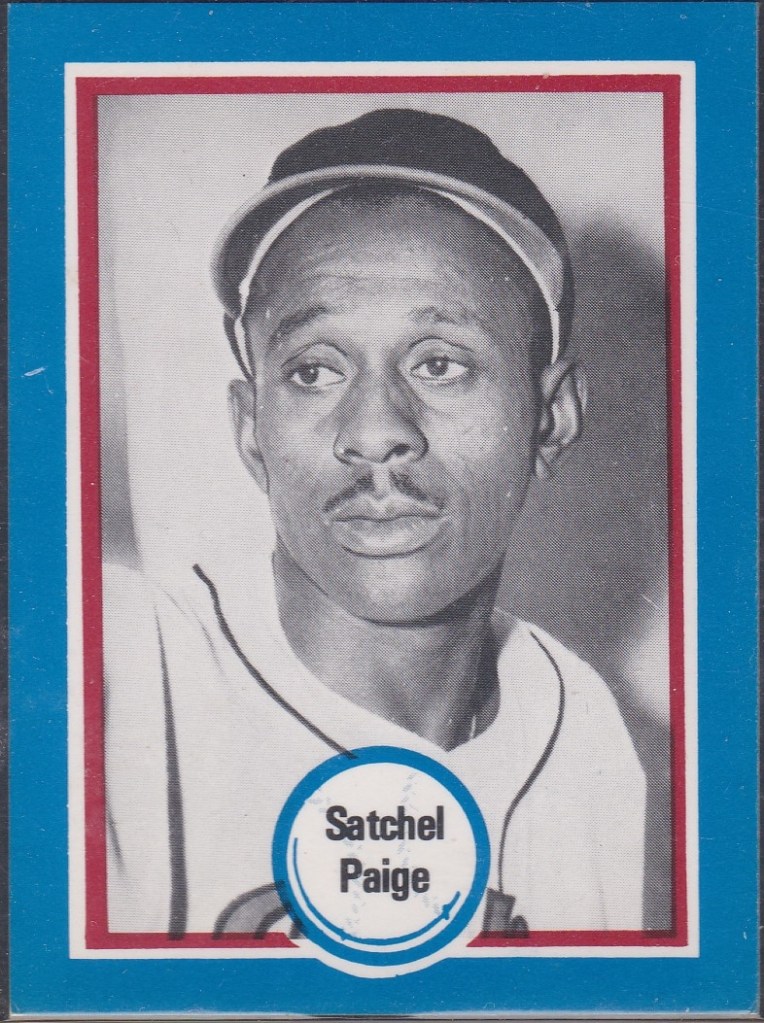
Satchel Paige arguably could be the greatest pitcher that ever was. As time passes and more of the accomplishments of his long career in the Negro Leagues are verified, it’s likely his case will grow stronger. He played professionally from the late 1920s into the 1960s.
Game accounts and box scores of his many appearances in Washington, with a couple of exceptions, already are available, thanks mostly to the tireless efforts of the volunteers at Retrosheet. Still, many gaps remain.
This post will attempt to provide details of Paige’s known games in D.C., Most of them were with the Kansas City Monarchs against the Homestead Grays, who made Griffith Stadium their primary home through the 1940s, and with Cleveland and St. Louis in American League.
His first appearance in D.C. and perhaps others, with the Pittsburgh Crawfords in the 1930s, have proved elusive to pin down.
With Paige’s stats from the Negro American and National Leagues being incorporated into the MLB records through the 1940s, a clearer picture of his dominance is emerging. Researchers are hard at work trying to find accounts of the hundreds of exhibition games Paige pitched against barnstorming major leaguers and top-flight Black teams. A complete picture probably will produce numbers that are jaw-dropping. In the meantime, there is Paige’s own account.
“He carried a notebook listing innings pitched, game scores, opponents, strikeouts, bases on balls…. The Paige almanac had him pitching in more than 2,500 games and winning 2,000 or so. He professed to have labored for 250 teams and thrown 250 shutouts…..The numbers were dizzying, but each required an asterisk explaining that Satchel kept records the way he set them: with flair, grace, and hoopla,” Larry Nye, author of Satchel: The Life and Times of an American Legend, wrote in his SABR biography of Paige. Given that Paige pitched – often year-round — into his late 50s, these figures might not be that exaggerated.
According to Brad Snyder, author of the definitive history of the Homestead Gray’s time in D.C., Beyond the Shadow of the Senators, Paige’s first appearance at Griffith Stadium came in the mid-1930s when he was star pitcher with the Crawfords. Although I haven’t found conclusive evidence of the game that was Paige’s first appearance in Washington, several stories in the Chicago Defender and other Black newspapers offer possibilities.
Paige pitched for the Pittsburgh Crawfords in 1932. Unaffiliated that season, the team played the Washington Pilots in a four-game series at Griffith Stadium that began on July 25. According to the Baltimore Afro-American’s game story, Paige did not pitch in a 5-1 Crawfords’ win. An Associated Negro Press story had the Crawfords winning the July 27 game in 11 innings, again with Paige not appearing. Pittsburgh also won, 11-6, on July 29. No mention of the Crawfords’ pitchers was made in that game or in a fourth game in any newspaper account.
On September 15, 1934, the Defender reported that the Crawfords would meet the Nashville Elite Giants on Sunday, September 16, at Griffith Stadium. The two Negro National League teams were playing a post-season series, and Nashville had balked at playing the final game in Pittsburgh. The Washington ballpark was picked as a neutral site. A brief September 29 story by the Associated Negro Press said that the Crawford beat Nashville, 6-2, on Tuesday, September 25, in Washington, thus collecting a $1,000 prize. No pitchers were mentioned. The story listed attendance as “just 2,500,” not the kind of crowd that would be expected if Paige was due to start a game.
With many of the star players not back from an all-star tournament in Denver, the Crawfords and Washington Elite Giants played to an 8-8 tie on Saturday, August 18, 1936, at Griffith Stadium. Paige almost certainly was not there. On August 20, with some of the players back, the Crawfords lost both games of a double header to the Elite Giants. (The franchise played league games in D.C. in 1936 and ’37.) The account of the games in the Defender mentioned the Crawfords’ two pitchers in the first game, but not the second, which Pittsburgh lost, 6-5, but the Crawfords’ lineup was described as “skeletonized,” making it unlikely Paige had returned.
Snyder wrote that Paige pitched two innings the first time he took the mound in Washington, which sounds like a relief appearance. Paige was with the Crawfords for all of 1933, 1934 and 1936. Of course, with coverage being as sporadic as it was and both the Crawfords and Elite Giants in the 1936 Negro National League, Pittsburgh might well have played in Washington more than once. I intend to keep searching.
Here are Paige’s confirmed games pitched at Griffith Stadium:
May 31, 1942: The next time Paige pitched in D.C. is well documented. He started an exhibition against the barnstorming Dizzy Dean All-Stars. The Kansas City Monarchs of the Negro American League agreed to loan Paige to the Homestead Grays of the Negro National League. The Grays, nominally based in Pittsburgh, had begun to play many of their home games at Griffith Stadium.
Dean’s team actually included just one active all-star, shortstop/third baseman Cecil Travis of the Senators. Travis, who hit .359 and led the A.L. in hits in 1941, had been drafted after the season and was on leave from the Army. Dean, whose injury at the 1937 All-Star game in D.C. likely shortened his career, already had retired to become a broadcaster. At Chicago’s Wrigley Field a week prior to the D.C. game, Paige and the Monarchs had defeated Dean’s team, 3-1.
The game, to raise money for the war effort, was the first time in 20 years that Senators’ owner Clark Griffith had agreed to allow a team of Black players to play an all-white team. A crowd of 22,000 showed up, many of them no doubt to see the famous Paige and the strong Grays’ team face the mix of white major and minor leaguers. Advance advertising claimed that Bob Feller, who was in the Navy, would oppose Paige. The city’s four daily newspapers, which rarely gave the Grays any coverage, had run advance stories about this exhibition and had sent reporters and columnists to write about it.
As it turned out, Feller could not get leave to attend, so Dean started the game. He was hit hard. Josh Gibson hit 420-foot drive for an out that would have been a home run anywhere but spacious Griffith Stadium. His teammates managed three hits, a walk and two runs off Dean in his one inning.
Paige, meanwhile, yielded an unearned run in the fourth and struck seven, including Travis, who had singled his first time up. The Grays won, 8-1. Snyder, now a law professor at Georgetown, discusses this game at length in Beyond the Shadow and credits Paige with popularizing the Grays’ games in Washington.
June 18, 1942: The Kansas City Monarchs, who had avoided playing the Grays for two years, finally came to D.C. with their star pitcher. Grays’ owner Cum Posey had finally agreed to meet Griffith’s price to turn on the stadium lights so the game could be played at night. It began at 9 p.m. (All the games against the Monarchs were considered exhibitions because the two teams were not in the same league.)
A capacity crowd of 28,000 showed up to see Paige start. He did not disappoint, pitching five shutout innings, allowing just three hits. Neither offense did much. The game was scoreless through nine. The Monarchs scored a run in the 10th, but the Grays answered with two in the bottom of the inning to win.
August 13, 1942: A crowd of 20,000+ saw another night game. Paige went the distance, only to lose, 3-2, in 12 innings to the Grays; In the midst of an injury-plagued season, Buck Leonard had a game-tying RBI single in the ninth.
September 8, 1942: Game one of the Monarchs vs. the Grays in the Negro Leagues’ championship series at Griffith drew a crowd of 25,000. Paige retired the first 10 batters and shut out the Grays for six innings. Kansas City won, 8-0, on the way to sweeping the series. The weather was rainy and humid. With two on in the fourth, Josh Gibson hit a ball over 400 feet that was caught on the warning track in left, where the fence was 428 feet away.
June 20, 1943: In a day game before 20,000+, the Grays pounded Paige, who gave up 7 runs in 3 innings in first game of a twin bill. His line: 6 hits, 7 runs, 3 BB, 3 Ks. The two Negro Leagues didn’t tally or credit unearned runs in the early 1940s. The Monarchs’ second baseman committed three errors and the center fielder one in this game.
August 10, 1943: Paige wasn’t scheduled to pitch in this night game, but the Grays delayed the start, as the crowd of 22,000+ was chanting for him until he took the mound. Satch pitched five shutout innings (2 hits, no runs, 2 BBs, 3 Ks). The Monarchs won, 11-3.
September 5, 1943: In a night game, the Grays knocked out Paige after four innings (10 hits, 6 runs, 1 BB, 2 Ks). He took the loss as the Grays won, 8-1, in the second game of a double header, The game was described in the Black press as “sparsely attended.” Retrosheet estimated a crowd of 8,000, which would only be “sparsely” in D.C. by the standard set by Paige.
June 25, 1944: Paige started and took the loss in the first game of the first of twin bill (3 innings, one unearned run, two hits, no BBs, 4 Ks). The Grays won, 2-0, before an estimated 15,000.
August 31, 1944: Paige started but pitched just 2 innings, giving up a run on one hit and a walk. He struck out four, and left with the game tied.
June 24, 1945: Paige gave up 10 hits, 9 runs in 6 inning (7 runs in the sixth), 2 BBs, 4 Ks), and took the loss; Grays won, 12-3
August 9, 1945: (night) Paige started the first game of a double header and pitched 3 shutout innings (no hits, no BB, 6 Ks), on loan to the Birmingham Black Barons. The Grays won, 13-7. Leaving the stadium, he made illegal left turn, according to Snyder’s book. A Black cop who claimed Paige tried to run him over punched him twice in the eye, then took him to the police station to pay a $5 fine. (Paige was always getting speeding tickets. He claimed he had gotten one in every state.)
July 10, 1946: The Monarchs lost to Baltimore Elite Giants, 9-3, at Griffith; Paige started, went 3 innings (no runs, 1 hit, 0 BBs, 1 K).
August 10, 1947: Paige started and went the distance in the seven-inning first game of a twin bill (6 innings, 5 hits 0 BBs, 6 Ks). The Grays won on an unearned run in the fifth, 2-1.
After several games with the Monarchs to begin 1948, Paige was signed by Cleveland owner Bill Veeck and brought to the majors at age 42 into a pennant race.
In the American League with Cleveland in D.C.
July 18, 1948: Paige first appeared against the Senators at Griffith Stadium in the second game of double header, pitching the 6th inning), one BB, two Ks (Cleveland won, 6-4). This was his third appearance, nine days after his debut against the Browns in Cleveland.
July 19, 1948: He pitched again in D.C. in relief (8th and 9th, gave up a hit and walk before being lifted in the 10th: no runs, 3 hits, 3 BBs, 1 K (Cleveland won, 7-6)
August 30, 1948: Before a capacity crowd, Paige started against the Senators and came close to pitching his third shutout of the month, cruising to a 10-1 victory, He gave up seven hits and one walk with five strikeouts. The Indians led, 10-0, before Washington scored a run in the eighth. This was Paige’s last decision of the year, leaving him with six wins and a loss. He also had beaten the Nats in an August 3 start in Cleveland before shutting out the White Sox on August 13 and 20.
May 25, 1949: He finished a 6-2 Cleveland defeat, pitching a scoreless 8th and 9th, walking one batter.
August 4, 1949: Paige came in with one out and a man on first after the Nats had taken a 2-1 lead in the 6th. He gave up a single, got a fly out and struck out a batter to strand the two runners. The Indians scored three in the 9th to win, 6-3.
September 16, 1949: Another two-thirds of an inning appearance, his last of the season, started out well. He came in with one out and two men on in the sixth and induced a double-play grounder. Left in for the 7th, a lead-off single and a double brought in a run and tied the score, 4-4. A botched play on a grounder put runners on second and third. Paige issued an intentional walk to load the bases and was relieved by Bob Feller. After a short fly out, Feller walked in a run, charged to Paige. Both runs were deemed earned. Paige was charged with the loss, leaving his record at 4-7.
Cleveland released Paige after the 1949 season. In 1950, he first pitched in the minors with Minot in the independent Manitoba-Dakota League, appearing in two games. In July, he signed with the Philadelphia Stars in the Negro American League and pitching in several games against semi-pro and barnstorming Black teams. He pitched once with the Stars at Griffith Stadium.
August 13, 1950: Against the Grays in D.C., Paige, started the first game of a double-header for the Stars and gave up 2 runs in 3 innings. The Grays, in what would be their final season, won, 7-1 or 7-2, depending on the source.
The next season, Veeck, the new owner of the St. Louis Browns, brought Paige, now 45, back to the majors.
July 29, 1951: He won in relief at Griffith Stadium after losing his debut in St. Louis against the Nats. He came in the seventh after Mickey Vernon had doubled in two runs to cut the Browns lead to 4-3. Paige immediately allowed a double that tied the score before retiring the side. He pitched a scoreless eighth, and St. Loius took an 8-4 lead with four in the 9th. The Nats made it interesting in the bottom of the 9th. Paige gave up two singles and a walk to load the bases with nobody out. A double-play grounder brought in a run. Then a grounder to short should have ended the game. Instead, an error made it 8-6. Paige finally got a game-ending ground out.
September 20, 1951: After the Browns had tied the game at 3 all, Paige pitched three scoreless innings in relief, yielding one hit, a walk and striking out 5. The run St. Louis scored in the eighth was the difference in a 5-4 win. This was his final victory of a season that he finished with a 3-4 record.
May 4, 1952: This was Paige’s worst A.L. outing at Griffith Stadium. He came in in the 4th with two outs, three runs in and a runner on first. The Browns were clinging to a 6-5 lead. Paige gave up three straight singles, allowing the inherited runner to score and two more, before striking out Pete Runnels. After holding the Nats scoreless in the fifth, he gave up a single, a triple, another single and a double to start the sixth. The double sent Paige to the showers. Sid Hudson, in relief, allowed a run charged to Paige and one of his own before getting out of the inning. Washington led 13-7 when the sixth ended and won 15-7. Paige took the loss, and was charged with 6 runs (5 earned) on 8 hits in an inning and a third.
June 3, 1952: In perhaps Paige’s best performance in relief, he came in with runners on first and second and one out in the 12th of a 2-2 game and induced a 4-6-3 double-play grounder. He proceeded to shut out the Nats for five innings, protecting the Browns’ one-run lead in the 17th for the 3-2 win.
July 18, 1952: Paige came in with one out in the 8th, two runners on and the Browns trailing by a run. After a fly out, Paige walked a batter to load the bases before inducing a grounder back to the mound to get out of it. St. Louis failed to score in the 9th and lost 3-2 anyway.
May 14, 1953: The Browns were losing 2-1 in the 7th when Paige came in with a man on first. He gave up a single to Eddie Yost and walked Mickey Vernon intentionally before getting out of it on grounder back to the mound, Again, the Brown could not score in the 9th and lost by a run.
June 23, 1953: With the Browns having taken a 3-1 lead in the top of the 7th, Paige was brought to try for a three-inning save. His first two innings went well, but the bottom of the 9th was an adventure. Jim Busby led off with a triple, A single brought him in and another single put runners at the corners. A sacrifice fly made the score 4-3. Eddie Yost’s liner to right was caught with the runner on first moving. The throw to first doubled him up, ending the game.
June 25, 1953: Two days later, Paige earned his ninth save with relative ease. He came in with the Browns up, 3-1, one out and a runner on in the seventh. He got a force-out grounder and a fly out to right. He retired the Nats one-two-three in the 8th with two strikeouts. After a walk and a single in the 9th, Paige got a foul pop out to third and a game ending double-play grounder.
August 9, 1953: Paige entered a scoreless game after a lead-off single in the 8th and got the win after the Browns scored three in the 9th. His wild pitch moved Eddie Yost to second. After two pop outs, Jackie Jensen walked. Then he and Yost pulled a double steal. But Paige got Pete Runnels to fly out. Busby’s singled to lead off the 9th but was erased on a 4-6-3 double play. An infield pop ended the game. The victory was his second against eight losses in what turned out to be his last time on Griffith Stadium’s mound in the majors. By this time, he was 47 years old and would finish the season having pitched in 57 games, saving 11.
PAIGE’S TOTALS IN THE A.L*: 179 games, 476 innings, 28 starts (7 CG, 4 SHUTOUTS), 28 wins, 31 losses, 34 saves, 429 hits (29 HRs), 174 ER (3.29 ERA), 180 BBs (30 IBBs), 288 Ks, 4 HBPs
*includes his 3 innings (I hit, 1 K) with Kansas City in September 1965 at age 59
 Washington baseball history