
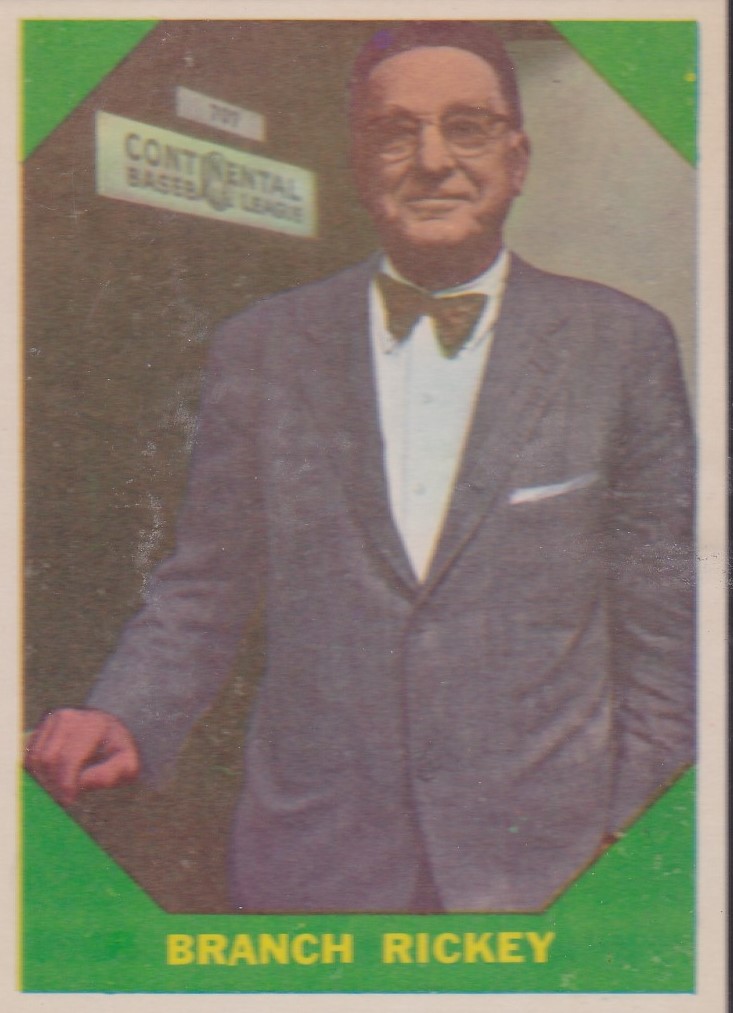
Before the New York Highlanders signed him in 1907, catcher Branch Rickey told manager Clark Griffith that a sore arm kept him from throwing well. Griffith, however, was desperate for a backup catcher.
On June 28, Griffith started Rickey behind the plate against the last-place Washington Nationals in a game at Hilltop Field in New York.
Based on newspaper accounts, both teams were often known by other than their official nicknames: New York newspaper headlines called the home team the “Yankees,” while Washington papers would call their team the “Senators.” Washington had been the “Senators” in the 1890s’ National League and from 1901 to 1904 in the new American League. New York abandoned “Highlanders” for “Yankees” after the 1912 season, while it took 50 years for Washington to finally give in and switch from “Nationals” to “Senators.”
Rickey, of course, would become known to history, not as a backup catcher but as a ground-breaking baseball executive. On this day, however, he set a record for futility that still stands.
According to the Games Project essay by SABR’s Laura H. Peebles, Griffith had to start Rickey because the Highlanders regular catcher, Red Kleinow, was injured. Washington’s first stolen base off Rickey came in a four-run run top of the first inning. The catcher’s throw sailed into right field.
The four runs in the first were enough for Griffith to replace his starter, Earl Moore, with rookie King Brockett, who yielded another run in the second. In the third, New York pulled off a double steal. The trail runner was the first of the season for slow-footed catcher Mike Heydon. It became obvious to Washington at this point Rickey could barely throw.
In the fourth, the Senators used three singles and a walk, plus five stolen bases to add four more runs. The short throw to third almost allowed Rickey to catch Jim Delahanty stealing his second base of the inning, but the umpire called the runner safe.
Despite an 11-2 lead in the seventh, Washington’s continued to take advantage of Rickey. A steal of third base was the only one New York tried off the sore-armed catcher. Going into the ninth, Washington had 11 stolen bases, and eventually Rickey stopped even trying to throw. Five hits and a walk led to two more successful steals and four runs. The final score was 16-5.
In addition to allowing the 13 stolen bases, Rickey struck out three times. Brockett was on the mound for 12 of the steals and may not have held the runners on well. Retrosheet has no play-by-play for this game, so Peebles’ Games Project story had to be derived from newspaper accounts.
Rickey’s career as a catcher was over after the 1907 season. As the Browns’ manager, he pinch hit twice in 1914, but never appeared behind the plate again.
Rickey went on to have a long and storied career as an executive for several teams, most notably the Brooklyn Dodgers, where he signed Jackie Robinson and began the integration of baseball.
 Washington baseball history