
Hastily assembled in December 1960, the expansion Senators lost 100 games four seasons in a row. Manager Gil Hodges, hired in May 1963, pushed for a trade of the Senators’s best pitcher, lefty Claude Osteen, to the Dodgers, for several unproven players and one slugging outfielder, 6-foot-7 Frank Howard.
“Hondo,” the beloved hero of so many young fans from 1965 through 1971, died at 87 on Oct. 30, 2023.
I spent a good bit of what little money I had as young teen in the early and mid ‘60s on packs of Topps baseball cards. I eagerly sought Senators’ cards, easily settling on big Frank as my favorite player. By the time he arrived, I was old enough to drive so I made the 20-minute trip with one of my buddies as often as we could to D.C. Stadium to pay $1.50 general admission and watch Howard do his best to play left field. The struggling Senators didn’t draw well, so the ushers always let us move down to the left-field boxes after a couple of innings.
Recently, SABR’s Baseball Card Research Committee encouraged its members to write about the best cards of their favorite players, which I was doing just as the news of Frank’s passing became known. My top-10 choices are available at sabrbaseballcardblog. Here is a shortened version:
During Howard’s playing days, my choices were restricted by the Topps monopoly, and surely seem a bit static compared with those of the 1980s and beyond. A multitude of post-career Howard cards are out there. I don’t have anywhere near all of them. Some are quite nice.
1964 Topps #139 World Series game as a Dodger
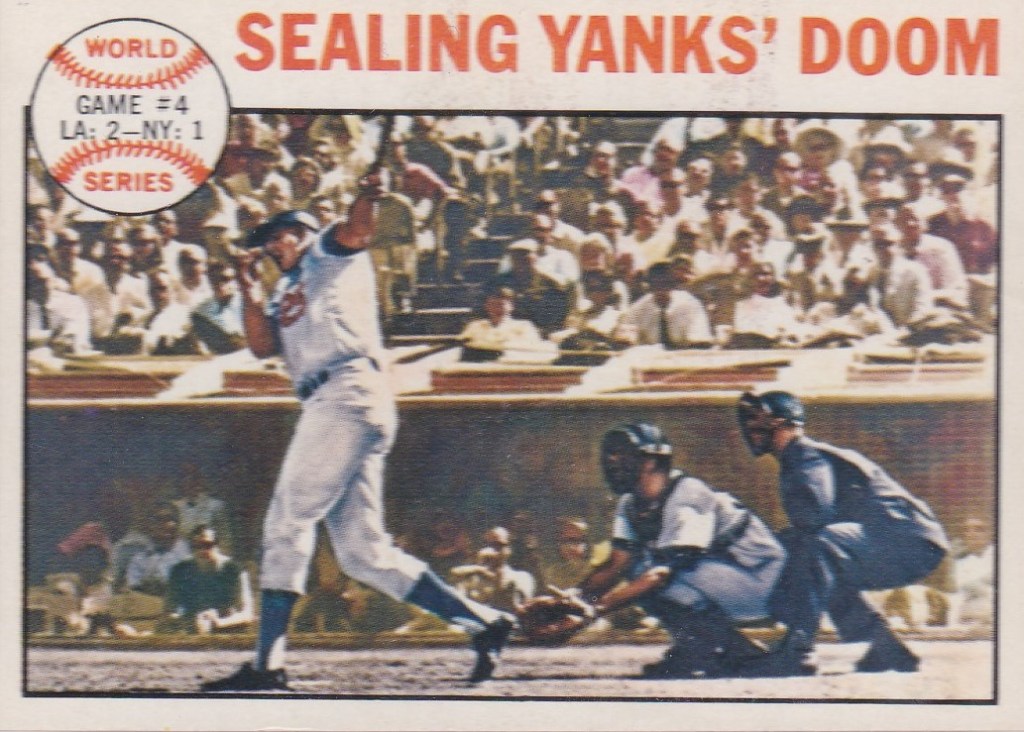
Howard’s homer off Whitey Ford in Game 4 of the 1963 Series in Los Angeles is featured in the World Series subset. It looks like Whitey’s pitch was meant to be below the strike zone, but Frank golfed it out. Howard’s homer didn’t by itself seal the doom – a Mantle homer tied it — but it sure helped in a 2-1 victory and Dodgers’ sweep. Such a big moment deserves a spot on my list.
1969 Topps #170
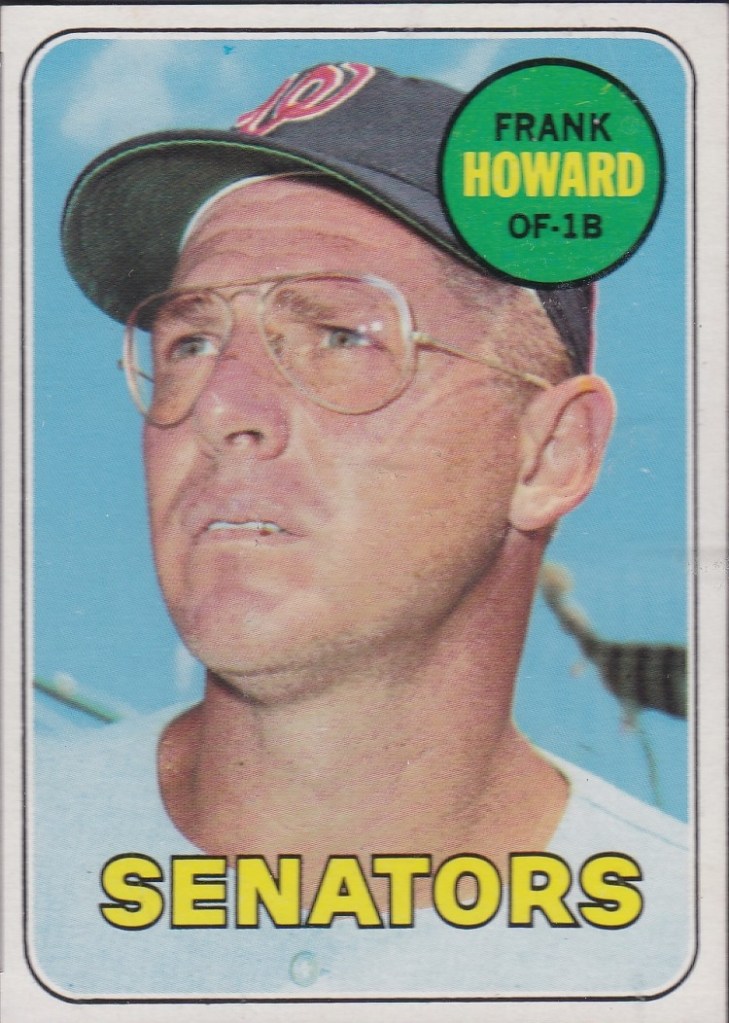
This one features the last photo of the blue cap with the curly W, the one the current Nationals wear, and the red piping, although the circle with his name covers up the piping.
1971 Kellogg’s 3D #14
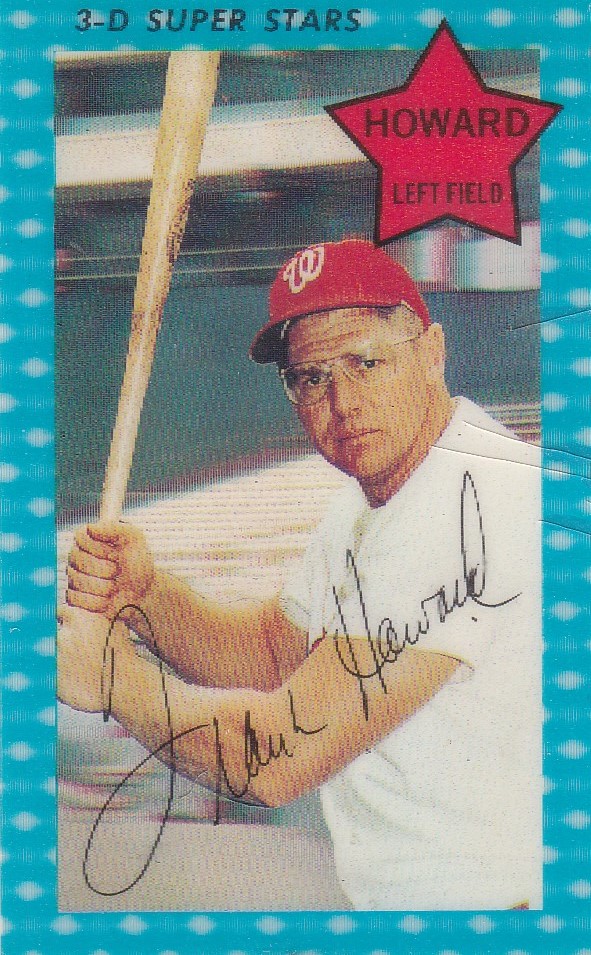
The best cards of Howard feature him with a bat in his hand, which is why this card makes my list. I admit I got this card long after he retired, but it’s a card from his playing days that isn’t a Topps and he’s in a white home uniform. The card also noted the nickname that was most familiar to his fans: “Hondo.” And it has a facsimile autograph of what appears to be Howard’s own signing style.
1968 Topps #320
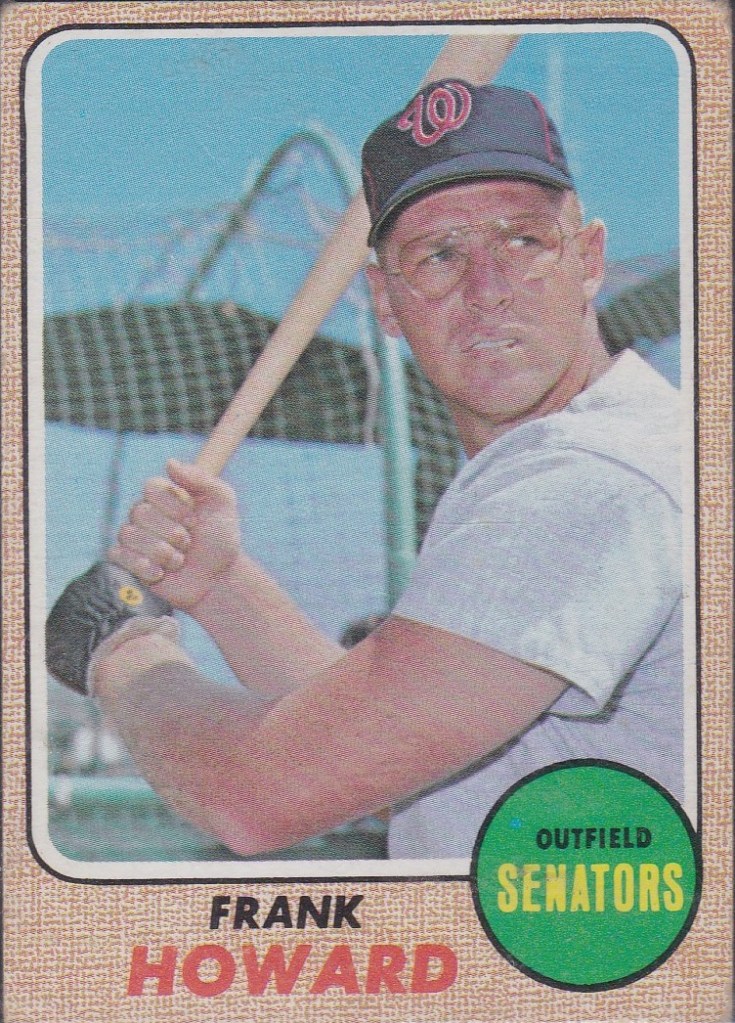
Howard in a batting stance, sans helmet. On his left hand, he wears some type of thick-looking batting glove, which nobody used in games back then, other than Ken Harrelson. The cartoon quiz on the back notes his status as a basketball All-America at Ohio State. He was an NBA draftee.
1994 Ted Williams Card Company #88
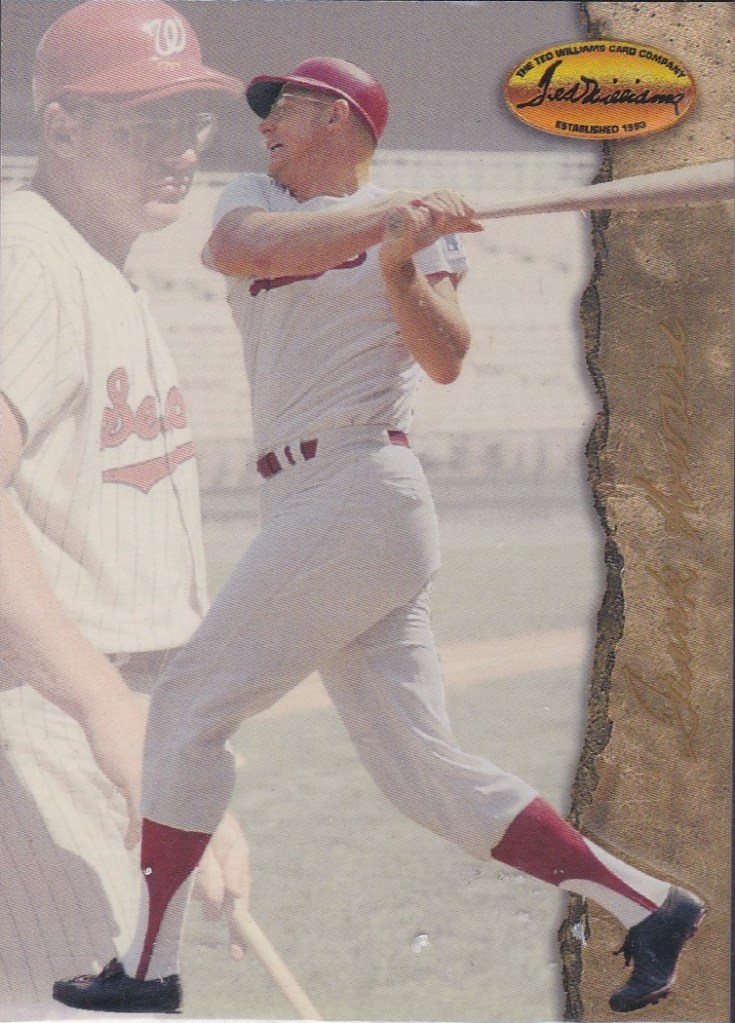
This Ted Williams series card shows Howard completing his powerful swing, stirrups over inner socks I would assume, in the all-white home uniform worn in 1969 through 1971, the years Ted himself managed the expansion team. The lighter secondary image shows him in a home uniform with pinstripes, which would have been from 1968, given his red helmet over what looks like a red cap. The back nicely lists stats from his five best seasons, although his career totals credit him with 1,119 doubles! I wish. (That was actually his RBI total.)
The back also features what look like a Howard autograph the way he signs them. The main giveaway is the true cursive F rather than the printed F on the two phony Topps autographs. I’ve included a scan of the Howard autograph that he signed for me outside D.C. Stadium before a June 1965 game with the Yankees (I got Mickey Mantle and Whitey Ford the same day. Still have ‘em) It’s similar to the cursive F in every Howard card with a purportedly genuine autograph that I’ve seen online.
1971 Topps #65: 1970 American League Home Run Leaders
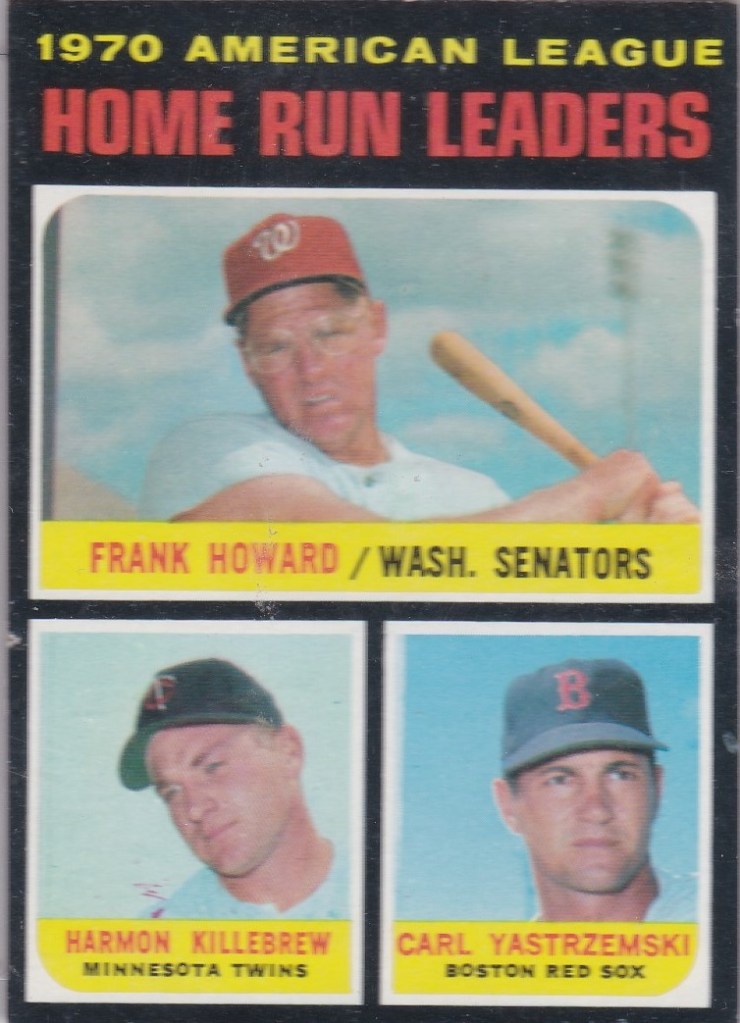
Although this was the second time Howard led in homers, this leader card has him atop Hall of Famers Harmon Killebrew, whose 49 topped Hondo’s 48 for the title in ’69, and Carl Yastrzemski. The Senators finished 10th in 1968, so the ’69 leader card can’t help but remind me of what Branch Rickey is often quoted as having told homer champ Ralph Kiner: “We can finish last without you.” The 1971 card followed the expansion team’s first (and only) winning record, and with Howard capping four seasons in which he hit more home runs that anybody else in the majors.
1966 Topps #515 — my favorite
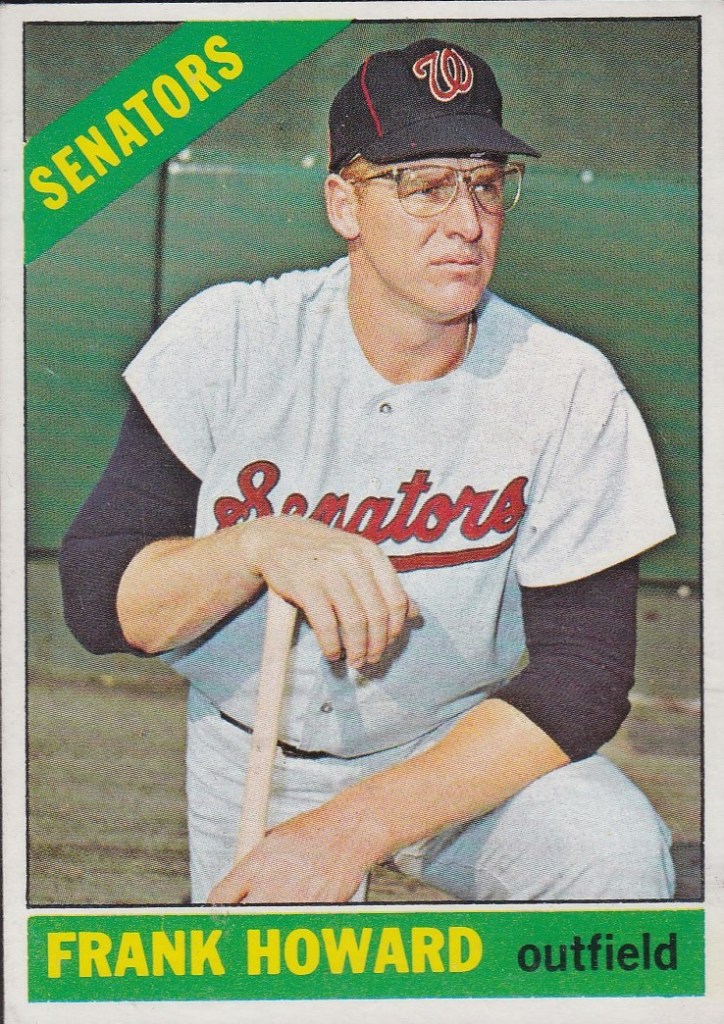
This card was his first as a Senator. Even though Howard was dealt to Washington on December 4, 1964, his ’65 Topps card shows him as a Dodger, while noting the trade on the back. In any case, this 1966 is a beauty: The bespectacled Howard kneeling as if on-deck, a good shot of the cap with the curly W and the red piping, the script “Senators” across his jersey. To my delight, this card accompanies Mark Armour’s SABR bio essay on Howard. His best seasons were yet to come, but Hondo was already the club’s foundation player.
I love wearing the Senators’ 1963 to ’68 blue curly W caps these days because people figure, correctly, that I’m a Nationals’ fan, but if they ask about it, I get to tell them that the hat is actually one the Senators wore back in the 1960s.
Howard hit the last Senators’ homer in the last game at what became Robert F. Kennedy Stadium, even if the pitch was admittedly grooved. He loved playing in D.C. He has a statue outside Nationals Park. His career did not make him a Hall of Famer, but he always will be one in the hearts of us aging Senators’ fans.
A longer version of this was posted on November 1, 1923, on SABR’s baseball card blog, under the heading “Hondo: the only expansion Senator fans remember.”
 Washington baseball history