
Baseball traditionalists chafe at the current setup that allows six teams from each league to make the post-season, but surely few of them want a return to the 1960s when the first round of expansion presented 15 opportunities for teams to finish 10th.
Thanks to the horrendous Cleveland Spiders, losers of 134 of 154 games in the 1899, the Washington Senators finished 11th in their last year in the National League. Washington was seven games behind the New York Giants but 35 games ahead of Cleveland.
When the American League expanded in 1961, a new Senators franchise – the third – was given the possibility of doing what no A.L. or N.L. team had been able to do in the 20th Century: finish ninth or 10th. The expansion Senators took full advantage of the opportunity. Washington finished tied with Kansas City for last place in 1961, finished 10th alone in 1962 and ’63, before getting “Off the Floor in ’64” — the modest motto for that season – to finish ninth.
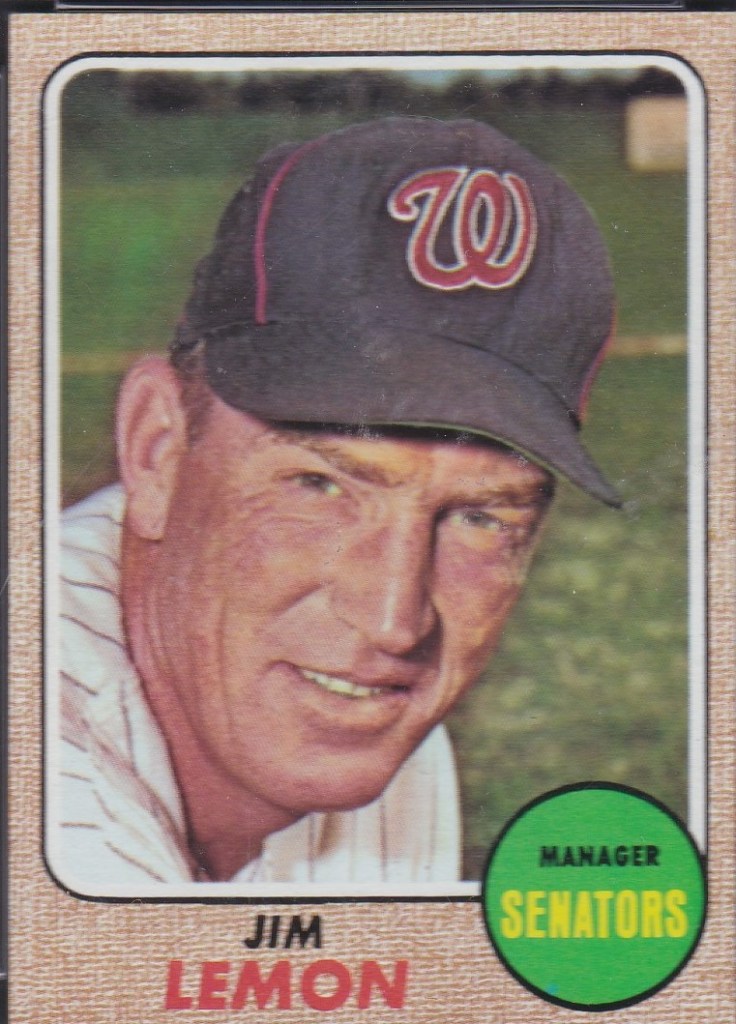
The expansion team slowly improved under manager Gil Hodges, so it looked like the last-place days were over. Sorry, not so fast. Hodges left to manage the New York Mets after the ’67 season, and Jim Lemon, a slugger with the old Senators, took over.
No one thing doomed the 1968 Senators. In fact, Frank Howard had a tremendous season in what’s rightly known as the Year of the Pitcher. Nonetheless, Washington had the dubious distinction of being the last A.L. team to finish 10th. The Houston Astros were the last 10th-place N.L. team, just a game behind the ninth-place Mets, who would win the ’69 World Series.
The Yankees — only two seasons removed from their fifth straight trip to the World Series — had finished 10th in 1966, a game behind the eighth-place Senators and half a game behind the ninth-place Red Sox. (Both the Senators and Yankees didn’t bother making up three postponed games and played only 159.) As the Mets would do in ’69, the Sox rose from ninth to first in 1967.
The Mets finished 10th five times and ninth twice. Thanks to ’68, the Senators finished 10th for a third time, matching the Kansas City Athletics. The Senators and A’s both finished ninth twice. Other than the Astros, the Cubs were the only other team to finish 10th.
Aside from the ignominy of finishing 10th, the Yankees did it the same year the Mets climbed out the cellar, creating a tricky trivia question: When did the Mets finally finish ahead of the Yanks in the standings?
The ’68 Senators finished 65-96, just 1.5 games behind both Chicago and Los Angeles, (tied at 67-95, so there was no final A.L. ninth-place team). Both leagues split into two, six-team, divisions as four expansion teams were added for 1969.
The ’68 team finished April four games over .500 at 11-7, but despite Frank Howard record homer streak in May, the month was a disaster. The Nats lost 21 of 28 games. Washington fell into the cellar in late May, escaped briefly in early June by winning seven of nine games, but was back in 10th place for good on June 11. Any chance the Nats had of escaping the basement disappeared when the team lost 11 of 13 games from September 4 to 21.
The ’68 Senators had much the same roster as the ’67 team, which won 11 more games, with the exception of Del Unser, who as a rookie took over center-field. In looking at the offensive performances, keep in mind that A.L. batters hit a collective .230 in 1968. The Senators as a team hit .224. The league earned run average for A.L. pitchers was 3.34; the Nats hurlers finished at 3.64.
The two most glaring offensive weaknesses were at shortstop and catcher. Weary of Ed Brinkman’s lack of production, Washington had traded for Ron Hansen in hopes of adding some pop to the lineup. Yet Hansen hit just .185 before the Senators traded him back to the White Sox at the beginning of August and went back to Brinkman, who hit .187. Catcher Paul Casanova slumped to .196. Backups Jim French and Billy Bryan hit .194 and .204 respectively, for a collective .197.
Howard’s .274 average ranked him in the top ten. His 44 homers led the league and his 106 RBIs ranked second. Ken McMullen hit 20 homers and, given the league average, hit a respectable .248. The other regulars hit between .230 and .241.
Joe Coleman emerged as a solid starter, leading the staff with 228 innings and a 3.27 ERA. Camilo Pascual had his last good season (2.69 ERA and four shutouts), and Jim Hannan returned as a starter to win 10 games with a 3.01 ERA.
Phil Ortega slumped badly, however, and Frank Bertani missed time in the National Guard. When available, he wasn’t as effective as he had been in ’67. Barry Moore was in and out of the starting rotation, despite a 2.37 ERA.
National Guard duty (this was the height of the Vietnam War) kept star closer Darold Knowles away from the team for half the season. Nats’ reliever had 15 blown saves, converting just under 67 percent of their opportunities. The league conversion average was 72 percent.
The bench was weak. Brant Alyea (.267) was the only reserve who got up at least 150 times and hit higher than .204.
Essentially, the ’68 Senators were not markedly worse statistically than the league as a whole, but were just bad enough in different areas across the board to end up 10th and last one final time.
Today, with extensive inter-league play obliterating the differences between the two leagues, a team can’t finish worse than fifth in its division. But if you grouped all 30 teams together, the 2022 Nationals (55-107) would have finished 30th. Perhaps 10th place wasn’t so bad after all.
A version of this appeared in the October 28, 2023, Here’s the Pitch, the online newsletter of the Internet Baseball Writers Association.
 Washington baseball history