
Shortstop Cecil Travis had a good enough career with the Senators that many argue he belongs in the Hall of Fame. Were it not for his nearly four years in the Army and a foot injury during World War II’s Battle of the Bulge, it’s quite possible he’d be a Hall of Famer. As it is, he earned a Bronze Star for his service.
Before he became a regular with the Senators, Travis had a record-setting debut on May 16, 1933, at Griffith Stadium. He had been called up from Chattanooga in the Southern Association, where he had been hitting over .400, to sub for the injured Ossie Bluege. The 19-year-old Travis singled his first four times up, scored three runs and added a fifth hit in Washington’s 12-inning victory, 11-10, over Cleveland.
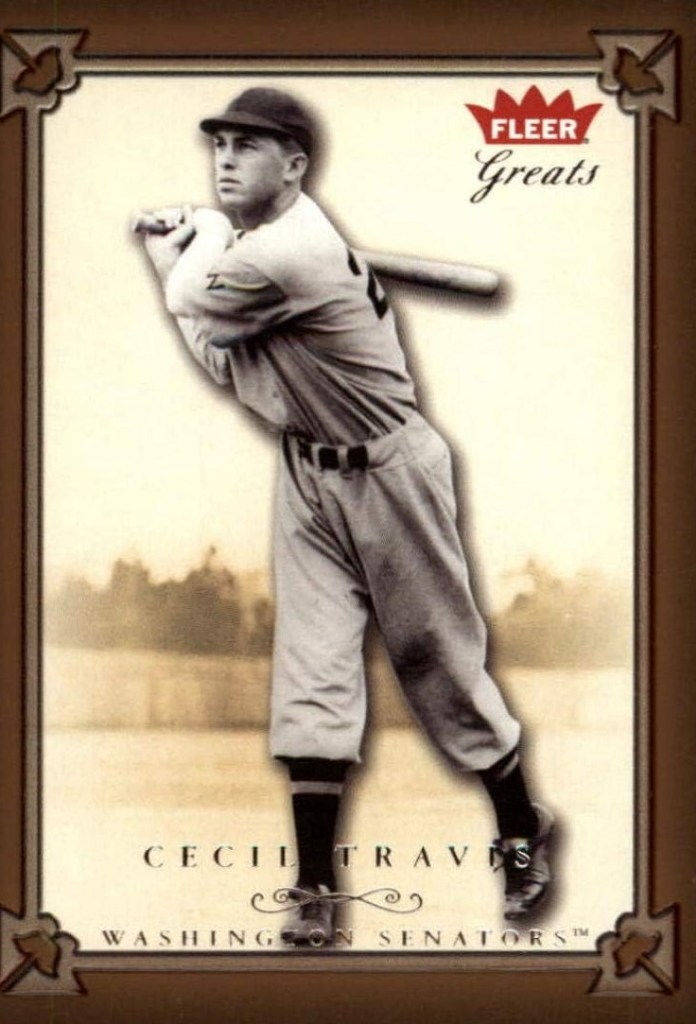
He was the first player in the 20th Century to collect five hits in his first major league game. Nobody since Travis has had a five-hit debut. (In 1894, Fred Clarke, an eventual Hall-of-Famer, had five hits in his first game.) Yet Travis never batted with anyone in scoring position, so he had no RBIs.
Playing third base, Travis neatly fielded a bunt by the Indians’ leadoff hitter, who was testing the rookie, and easily threw him out.
In its first issue of 2024, Baseball Digest ranked the five-hit game by Travis as the 10th best debut in MLB history. (The debut of the Nationals’ Stephen Strasburg in 2010 was no. 1.)
Travis followed up his five-hit game with two more the next day. But after starting off 8-for-15, he had just one hit in his next 14 at-bats. Another rookie, Bob Boken, then started several games at third. So once Bluege recovered from his foot injury, Travis was sent back to the minors, where he remained until a September call-up. Still, his average in 18 A.L. games was .302.
His first taste of the majors was the last year the Griffith Senators won the pennant, and Travis was voted a World Series share by his teammates. The next season he won a regular spot in the Washington lineup. He went on to hit .317 or higher seven of the next eight years. The exception was 1939 when illness limited him to 130 games, but he still hit .292.
In 1941, Travis had his best season, leading the majors in hits with 218. His .359 average topped MVP Joe DiMaggio’s .357 and was second to the .406 of Ted Williams. Sadly, at 27, this was to be his last good year.
When he returned from the Army for the final month of the 1945 season, his timing, mobility and foot speed were not the same. He played regularly in 1946, but hit just .252. In a part-time role in 1947, he slumped to .216 and decided to retire.
Even so, his .314 lifetime average tops many Hall-of-Fame infielders. The only player who was predominantly a shortstop with a higher lifetime average than Travis is Derek Jeter (.316). The only shortstop with a higher single-season average than Travis in 1941 was Luke Appling in 1936 (.388). Both of them are Hall-of-Famers.
Rob Kirkpatrick wrote SABR’s BioProject essay on Travis and is the author of a book-length biography, Cecil Travis of the Washington Senators (2005, University of Nebraska Press), which provides a full account of his life.
 Washington baseball history