
The 1963 Topps baseball card set has 576 cards, but famously not one is of the reigning National League MVP, Maury Wills. The story is that in the spring of 1959, Wills wasn’t offered $5 to sign the standard Topps contract to put his image on a card because he wasn’t a good enough prospect.
All the other players pictured on the 1963 Fleer 66-card set also have cards in the 1963 Topps set, except one: pitcher Tom Cheney of the Washington Senators. There’s no disputing that Cheney was little known at the time, but unlike Wills, whose 104 stolen bases are no longer the record, Cheney had set a mark in 1962 that still stands.
On September 12, 1962, in Baltimore, Cheney struck out 21 Orioles. The game — and Cheney — went 16 innings, but at the time, the record for strikeouts by a pitcher in a game of any length was just 18.
Bob Feller and Sandy Koufax had fanned 18 batters in nine-inning game before Cheney’s 21. Seven seasons later, Steve Carlton would strike out 19 New York Mets (and lose). In 1986, Roger Clemens was the first to fan 20 batters in nine innings.
Yet as even a record number of batters have been striking out over the past few seasons, fewer and fewer starting pitchers have gone the distance. Complete games have become a rarity. No starter is ever likely to pitch beyond the ninth inning.
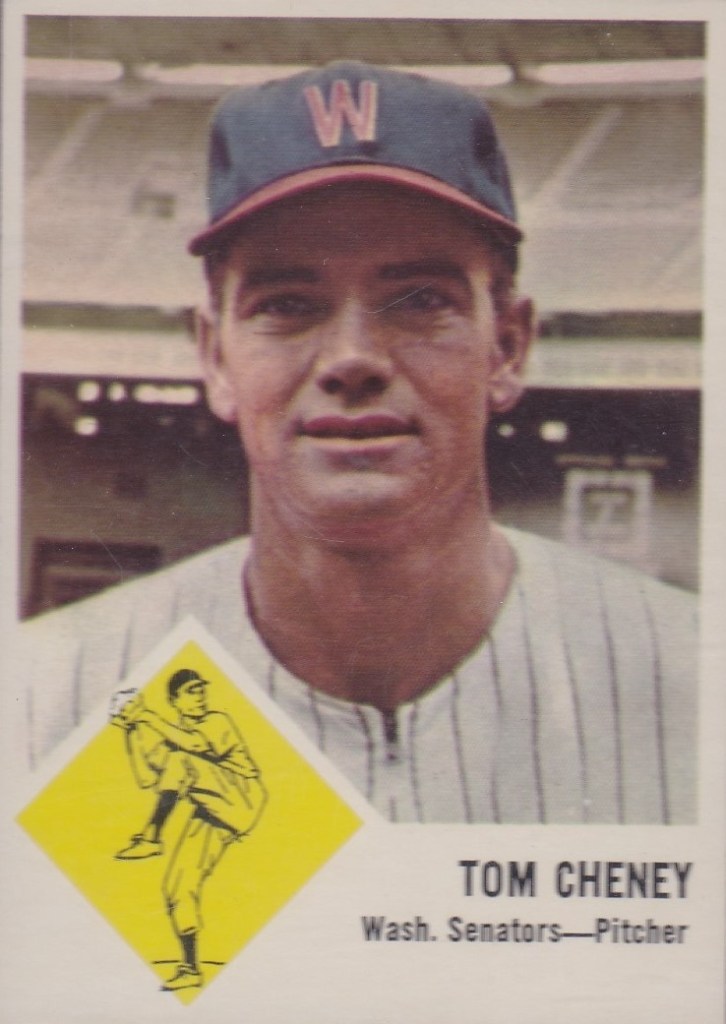
All of which means Cheney’s record probably will stand longer than the six decades that it already has. His 1963 Fleer card (#27) appropriately makes note of his 21-strikeout game.
Nothing in newspaper archives explains why Cheney did not have a Topps card after the 1961 set, when he still was with the Pirates. Presumably, he signed for five years with Fleer in 1962 when Fleer didn’t produce a set of current players. He also appears on a Post/Jello card (#99) in 1963 that had to be hand-cut from boxes of the products.
Cheney had a 1957 Topps card with the Cardinals, but despite pitching for Washington into the 1966 season, he never appeared on a Topps card as a Senator.
After Topps won its suit against Fleer over the 1963 set and maintained its card monopoly, Fleer supposedly turned over its player contracts to Topps, not that it mattered much for anyone other than Wills and Cheney. Wills finally got a Topps card with the Pirates in 1967. By then, Cheney, beset by arm trouble, had called it quits.
Wills, by the way, is one of a handful of players born in Washington, D.C., and clearly the most famous. He was just short of his 90th birthday when he died in September 2022.
Topps had the gall to fake a 1962 card of Wills in its 1975 set. In the series of former MVPs (# 200), Wills is paired with Mickey Mantle in the wood-grain trim of the ’62 set. Topps repeated the same phony ’62 Wills in a 1987 “Turn Back the Clock” card as did Kmart for its 20th anniversary set.
At least two retrospective sets included cards of Cheney. In 1978, Cheney was featured in the “TCMA the 1960s” set. In 2011, Cheney, who died in 2001, appeared in the TriStar Obek set (#11), which also makes note of the 21-strikeout game.
A version of this appeared as an August 5, 2023, post on the SABR Baseball Card Research Committee blog.
 Washington baseball history