
April 14 is the anniversary of two of the best games Washington’s Walter Johnson pitched in his magnificent career. On that date in 1926, at age 39, he went 15 innings to beat the Philadelphia Athletics, 1-0. He allowed six hits and let no runner advance beyond first base. Johnson himself considered this his masterpiece, according to his grandson and biographer, Henry W. Thomas.
On April 14, 1910, after President William Howard Taft threw out a ceremonial first pitch to him, Johnson shut out the A’s, who went on to win the World Series, 3-0, on one hit. It might have been a no-hitter, if a routine fly ball had not been misplayed because the outfield had been roped off to allow more fans. This was the first of Johnson record nine opening-day wins and one of his six career one-hitters.
Setting aside arguments about the impact of night baseball, integration, new pitches and use of relievers, can one man be deemed the greatest ever? That has been debated for nearly a century now (at least since Johnson retired after 1927). He always has been among the three or four who have been in the discussion, along with Christy Mathewson, Cy Young and Grover Cleveland Alexander.
Bob Feller, whose four years in the Navy in his prime leaves him just short of this discussion, wrote that Johnson was faster and “so great that he almost belongs in his own Hall of Fame.” Bill James rated Johnson as the all-time greatest. So have so many other respected baseball authors and experts.

Mathewson and Johnson were the two pitchers among the first five inductees into the Hall of Fame. Young is the all-time leader in victories with 511. Johnson is no 2 with 417. Young had died the year before Commissioner Ford Frick created the “Cy Young Award” for the season’s top pitcher, long before sabermetric stats were introduced.
Alexander had 15 seasons of 15 or more wins to Mathewson’s 13 and won 30 or more games in a season three times to Johnson’s two. He is second to Johnson in all-time shutouts, ahead of Mathewson. Alexander led the N.L. in wins, ERA and strikeouts four times to twice each by Mathewson and by Johnson in the A.L. More significantly, all three had seasons among the 10 best ever by allowing the fewest base runners per inning (WHIP), a measure that includes today’s pitchers.
No other pre-World War II pitcher ranks with these four in career stats. Lefty Grove, who didn’t pitch as much or as long, came close. He led the league in ERA nine times from 1926 to 1939 and won 300 games — great, especially among left-handers, but not the G.O.A.T. While Young belongs in the discussion, he pitched a decade in the 19th Century, including three before the pitching distance was set at 60-feet-6-inches in 1893, among many lesser rule changes.
Johnson and Alexander pitched into the live-ball era, but obviously the game has evolved since their time. Pitchers’ victories rightly are no longer held in such high esteem. Statistics such as fielding-independent pitching and WHIP, are considered better performance measures. Far more batters strike out, inflating that stat for today’s pitchers.
Still, thanks mostly to outstanding work by Retrosheet researchers, advanced metrics now apply to the greats of the early 20th Century, too. And as with modern Hall-of-Famers, they should be judged in the context of how the game was played in their era. Johnson and Mathewson were among the top strikeout pitchers at a time when batters seldom struck out. Johnson became the all-time leader in whiffs on Sept. 10, 1921. Nolan Ryan did not pass him until April 1983. Today, Johnson is barely in the top 10.
Now that the best pitchers rarely last even eight innings, the shutouts thrown by Johnson (110), Alexander (90) and Mathewson (79) should safely remain 1-2-3 on the all-time list. In the 20th Century, the lowest WHIP by a starting pitcher – a record unknown in his time – was achieved retrospectively by Johnson – 0.7803 – in 1913. But in 2000, Pedro Martinez finally beat that mark with a record-low WHIP of 0.7373.
Johnson led the American League in strikeouts 12 times, eight seasons consecutively. His ERA was less than 2.00 during 11 seasons. He led the league five times. His career 166.9 wins above a replacement player (WAR) by Baseball Reference’s measure, is the highest for any pitcher. Young is second at 163.6.
Johnson and Nolan Ryan are tied for the most 100+ performances in Bill James’s widely accepted Game Score standard with four each.
During his first five seasons, Johnson played for teams that finished either seventh or eighth, losing as many 110 games in 1909. During the same period, Mathewson’s teams finished at least 11 games over .500 and won 91 or more games four times.
A record perhaps as unbreakable as Johnson’s shutouts: He was charged with the loss in 107 games in which he allowed just one earned run. The no. 2 pitcher in that sad category lost just 77 that way. As MLB senior writer Anthony Castrovince wrote in 2020, “With proper support … Johnson would have challenged Young’s [511 wins’] record– and maybe even had a certain award named after him.”
Before Johnson arrived in the A.L., Mathewson had pitched for N.L. pennant winners that won 106 and 105 games. He famously threw three shutouts in the 1905 World Series. He pitched in three more World Series in 1911, ’12 and ’13. Johnson’s teams were mostly middle-of-the-pack through the teens and early ’20s but didn’t come close to reaching the World Series until the tail end of Johnson’s career.
Hank Thomas devoted an appendix in his 1995 biography, Walter Johnson, Baseball’s Big Train, to the debate about the all-time greatest. He posited that Mathewson’s having played in New York, the largest city with the most newspapers, likely contributed to Big Six getting more support among the 226 baseball writers than Johnson for the initial Hall of Fame class. Both still garnered more than the required 75 percent, which Young and Alexander did not.
Thomas then cited several broad-based votes, from 1950 through 1987, by a mix of baseball writers, players, authors and entertainers. The first two picked Johnson as the top pitcher of all time; the next two picked him as the top right-hander. Grove was the top left-hander on the Bicentennial Team in 1969 as was Sandy Koufax on the Players’ Choice team in 1987.
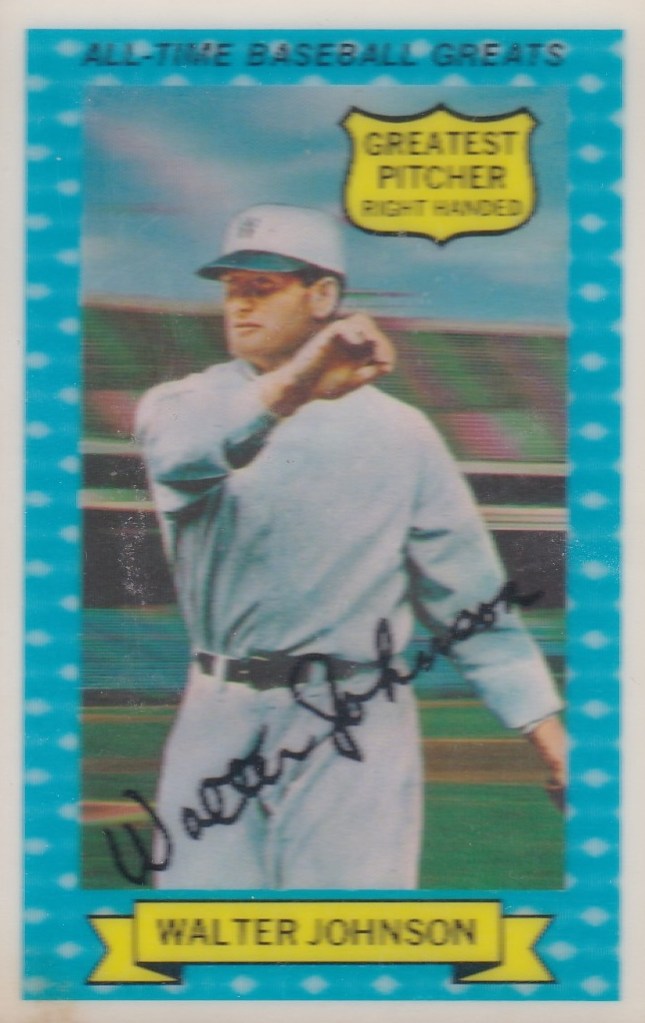
Card #1 in the 1972 Kellogg’s set features Johnson and proclaims him as the “GREATEST PITCHER/RIGHT HANDED, based in the list of “Greatest Players Ever” in the first 100 years of baseball selected by “Baseball Writers of America.”
Although Sports Illustrated made Mathewson the right-hander and Warren Spahn the lefty on its 1992 Dream Team, the magazine Inside Sports in 1994 went with Johnson as the top pitcher among its choices for the 20 greatest players of all time. That same year, Baseball Digest picked Johnson as the greatest right-hander and Koufax as the greatest lefty. Thomas also noted that Daniel Okrent and Harris Lewine had picked Johnson as the best ever in 1979’s The Ultimate Baseball Book. Maury Allen did the same in his 1981 book, Baseball’s 100.
In 1989, Total Baseball, soon to become the game’s official encyclopedia with Pete Palmer and John Thorn as its primary authors, named Johnson as the top pitcher on its list of greatest players. The debate will continue.
In the Spring 2023 issue of Baseball Research Journal, SABR member David J. Gordon, a retired cardiovascular physician, introduced a new measure for historical comparisons called Standardized Peak WAR (SPW). By using a standard involving batters faced during their best seasons, this measure attempts to compare fairly workhorse pitchers of the dead-ball era with modern starters and relievers. Dr. Gordon’s SPW ranks Mariano Rivera first, Martinez second and Walter Johnson third, far ahead of Grove (6th), Young (14th), Mathewson (20th), Alexander (22nd) and Koufax (27th).
Perhaps, other 20th or early 21st century pitcher yet may be mentioned with Johnson as more metrics emerge. The inclusion of Negro League stats in the mix certainly puts Satchel Paige and perhaps others in the discussion as research continues. For now, however, I rest my case on the side of Thomas for Walter Johnson, who without debate was the greatest player ever to wear a Washington uniform.
 Washington baseball history