
June 7, 2018 (updated 2021, 2023):
The film “Little Big League” from 1994, directed by Andrew Scheinman, with a screenplay by Gregory Pincus and Adam Scheinman (the director’s brother), has several clear, if coincidental, connections to the Senators. The premise of the movie is that a 12-year-old, played by Luke Edwards, inherits the Minnesota Twins from his long-time owner/grandfather (modeled on Calvin Griffith and played by Jason Robards Jr.).
The grandfather tells of how as a youngster he missed a chance to see Washington’s Walter Johnson, “the greatest pitcher ever,” pitch. The Twins’ GM is named Goslin — the same last name as Senators Hall-of-Fame slugger “Goose” Goslin. Of course, the Twins are the relocated original Senators.
Although I’m sure many people consider this a film for kids, I consider it one of the best baseball movies ever. Don’t take my word for it: Here’s a link to Roger Ebert’s thumbs-up review.
My love for this film existed before I became aware of its how its reputation has grown as it approaches its 30th anniversary.
“Little Big League” reached theaters in the summer of 1994, about the same time as Disney’s reboot of “Angels in the Outfield.” “The Sandlot” had been released the year before. Both crushed “Little Big League” at the box office, which helps explain why it just hasn’t received the attention it deserves. Pincus, who did the initial script based on his concept, was a first-time screenwriter. Although Scheinman had TV credits, this was his first directoral effort. Robards, whose part was relatively small, if significant, was the only well-known actor.
In a November 2023 email, Pincus, on whose story the film was based, told me he can’t explain the Senators’ references. His original script had the team being the Kansas City Royals, which would have made the Senators’ ties far less likely. Because people other than Adam Scheinman worked on script revisions, Pincus wrote that it’s possible a baseball buff could have inserted the references. It remains a strange series of coincidences in that case.
On July 15, 2014, the Kansas City Star published an appreciation by Rustin Dodd under the headline, ‘The forgotten brilliance and influence of ‘Little Big League.’” He rightly noted, the film has grown in stature as a precursor to the whole field of sabermetrics.
The 12-year-old, “Billy Heywood,” Dodd wrote, hated the bunt. Early in the film, Billy tell Twins’ GM Arthur Goslin and pitching coach (“Mac” MacNally) that he’s naming himself the new manager.
“It’s not that easy. There are situations,” Mac tells young Billy. “Try me,” Billy responds. Mac tries to stump him by asking what he would do in a late-inning situation: Twins up, man on first, none out. middle of the order. Billy fires back key questions – who’s the batter, what inning, home or way, who’s rested in the bullpen? and so on. Mac says the Twins should bunt, but Billy counters with what the Yankees would do to neutralize the threat by likely switching pitchers or intentionally walking the Twins best hitter. “Not a productive trip through our lineup,” Billy explains.
Admitting defeat, Mac tells the GM, “What does he need me for?”
Here’s a key part of what Dodd wrote:
“In the summer of 1994, the sabermetric revolution was in its infancy. Web sites like Baseball Prospectus and FanGraphs were still years away; Billy Beane was just an assistant general manger in Oakland…. But here was Billy Heywood, offering a cold and pragmatic takedown of the bunt as sound baseball strategy.
‘It may be the greatest distillation of sabermetric thinking into a soundbite that’s ever been filmed,” says Rany Jazayerli, a founder of Baseball Prospectus and long-time baseball writer. “And that includes ‘Moneyball.’”
In the film, Randy Johnson, Ken Griffey Jr., Lou Pinella (did you know he was with the expansion Senators in the spring of 1963?) and other big leaguers at the time play themselves. Kevin Elster and Leon Durham are Twins players as members of the cast. (On a 2021 Mets broadcast, Keith Hernandez claimed he was asked to play a role in the film, but like Elster and Durham, was supposed to be part of the fictional Twins team rather than playing himself. Hernandez declined.)
Billy Heywood, the young owner, is insulted by the manager who was hired by his grandfather. (A Bill Haywood — slightly different spelling — pitched in 14 games for the Senators in 1968.) The manager is played by Dennis Farina (seen on TV in several seasons of the original Law & Order). So Billy fires him, but has trouble finding anybody willing to manage for a kid boss.
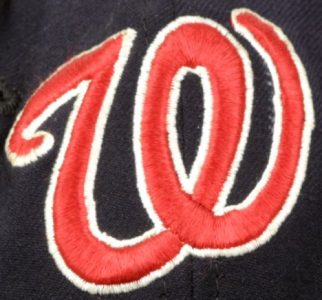
In one scene, young Billy, frustrated at a losing streak, wanders through a neighborhood in Chicago where a bunch of kids his age are organizing a stick-ball game. He asks if they need another player. One of the kids is wearing a hat with a red block W like the Senators wore in the 1950s. The W hat is clearly seen again later when the stick-ball game ends. Why in Chicago in the 1990s would anybody be wearing an old Senators’ hat?
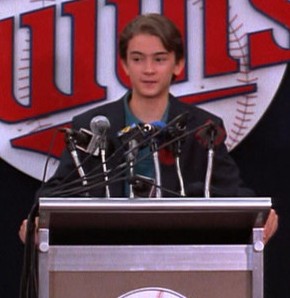
Ashley Crow, who plays Billy’s mother, later had a son who became a top draft pick in 2020: Pete Crow-Armstrong. He made his MLB debut with the Cubs in 2023 and has become a Gold-Glove regular in center.
“I love that movie, regardless of my mom being in it,” the young outfielder told the Los Angeles Times about watching it growing up. “It’s a great movie.”
In the film, the Twins are in a one-game playoff for a post-season berth. Their third baseman lets a ball go through his legs, which allows the go-ahead run to score. The young manager sits beside him on the bench and tells of how in the 1924 World Series, a ball got by the third baseman and a run scored. But when that player got up in the bottom of the inning, he got the game-winning hit.
After the Twins player gets in the on-deck circle, Mac, the pitching coach, tells the kid that the ball that got by the third baseman in 1924 let the winning run score (in game seven, giving Washington’s A.L. team its only World Series triumph.) The kid manager says to the coach, “I know that. He doesn’t.” Just one of many funny scenes in an under-rated baseball film.
(See Earl McNeely, World Series Hero —
https://wordpress.com/post/washingtonbaseballhistory.com/512
— elsewhere on this site.)
A version of this appeared on Jan. 6, 2024, in Here’s the Pitch, the daily online newsletter of the Internet Baseball Writers Association.
 Washington baseball history